Disclosure: As an Amazon Associate, I earn from qualifying purchases.
The standard advice for keeping a cat in a small flat is to buy less stuff. It’s not wrong exactly, but it’s solving the wrong problem — because the thing your cat is short of usually isn’t stuff. It’s territory.
And here’s the useful part: territory, for a cat, is measured in volume, not floor area. You can’t make your living room wider. You can absolutely make it taller.
That single shift is why a 40 m² flat can be a perfectly good home for a cat, and why some much larger flats aren’t. Below is how to do it, plus the six things that actually earn their footprint.
Why vertical space works
Cats evolved to use height. A raised position gives a wide field of view, an escape route, and distance from anything unpredictable at ground level — which in a flat means the door, the hoover, and visitors’ feet.
Three things follow from that, and they’re worth knowing before you buy anything:
Height reduces stress. A cat with somewhere high to retreat to has an option other than hiding under the bed. In practice this shows up as a cat who stays in the room when guests arrive instead of vanishing for the evening.
Height reduces conflict between cats. Two cats in a small flat with only floor space are permanently in each other’s territory. Add vertical levels and they can share a room while occupying different zones. This is one of the most reliable fixes for low-level tension between housemate cats.
Height is free. The wall above waist height in most flats is doing nothing. It’s the only square footage you can add without moving.
The other principle worth holding onto: sightlines matter as much as height. A shelf facing a blank wall gets ignored. A perch with a view of the room, or of the window, gets used constantly. Before mounting anything, sit on the floor where it’ll go and ask what the cat would be looking at.
What actually earns its space
1. A window perch — the highest-value square foot in the flat
If you buy one thing on this list, buy this.
A suction-mounted hammock puts your cat at the window with zero floor footprint. Window watching is the single most reliable form of enrichment for an indoor cat — movement, birds, weather, people — and it costs you nothing but wall.
The suction cups are the whole product, so don’t buy the cheapest. Look for four large cups rather than three small ones, and clean both the cups and the glass before mounting; grease is what makes them fail. Mount it low the first week so a fall isn’t a fall, then raise it once you’ve seen it hold.
2. Wall shelves — the actual solution
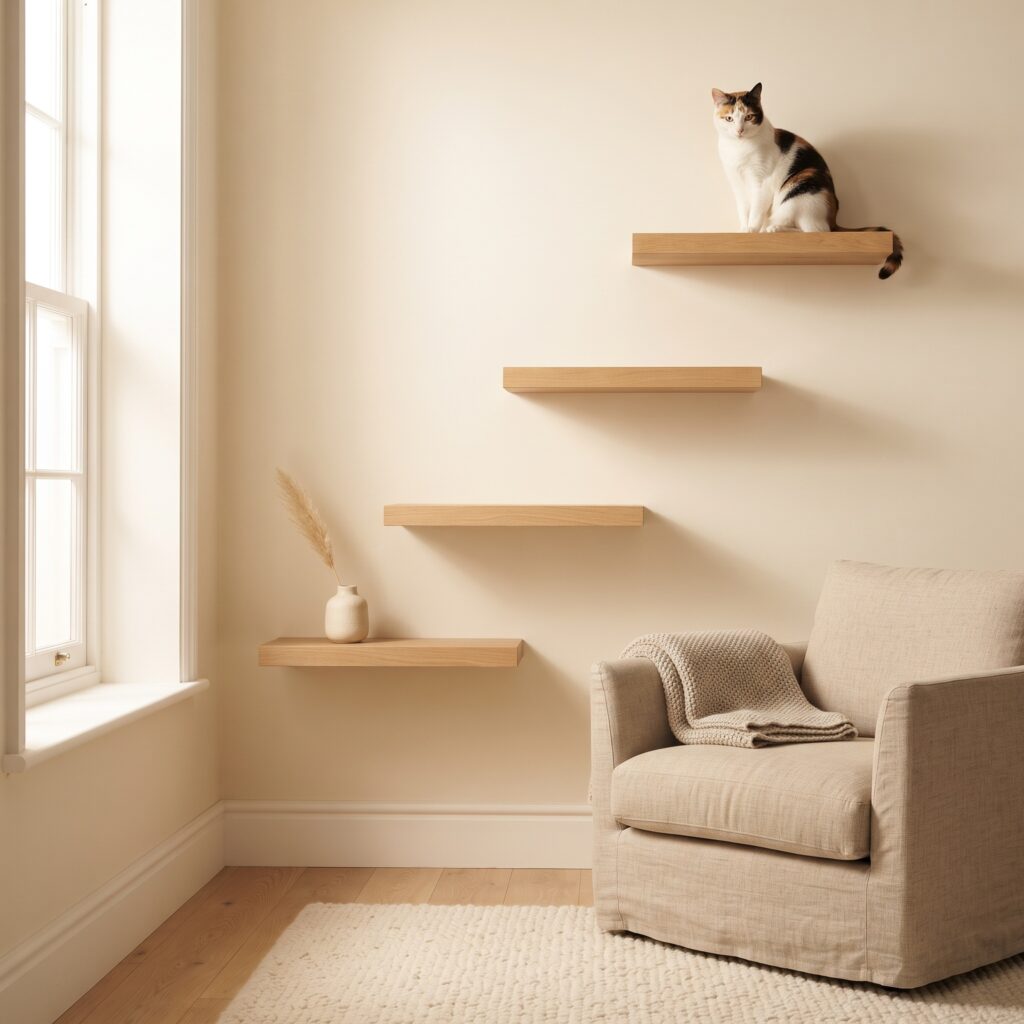
A set of wall-mounted shelves and steps turns an empty wall into a route. Done properly, your cat can get from floor to the top of a bookcase without touching the ground.
The design rule that matters: shelves need to form a path, not a display. Spacing of roughly 30–40 cm vertically and staggered horizontally, so each step is an easy hop. Too far apart and they won’t use it; perfectly in a vertical line and they can’t.
Give it a destination — the top step should lead somewhere good, like a perch by the window or the top of a cupboard. A route to nowhere doesn’t get walked.
Fix into studs or use proper wall anchors. A shelf that shifts once will never be trusted again.
3. Hidden litter box furniture — the biggest visual win
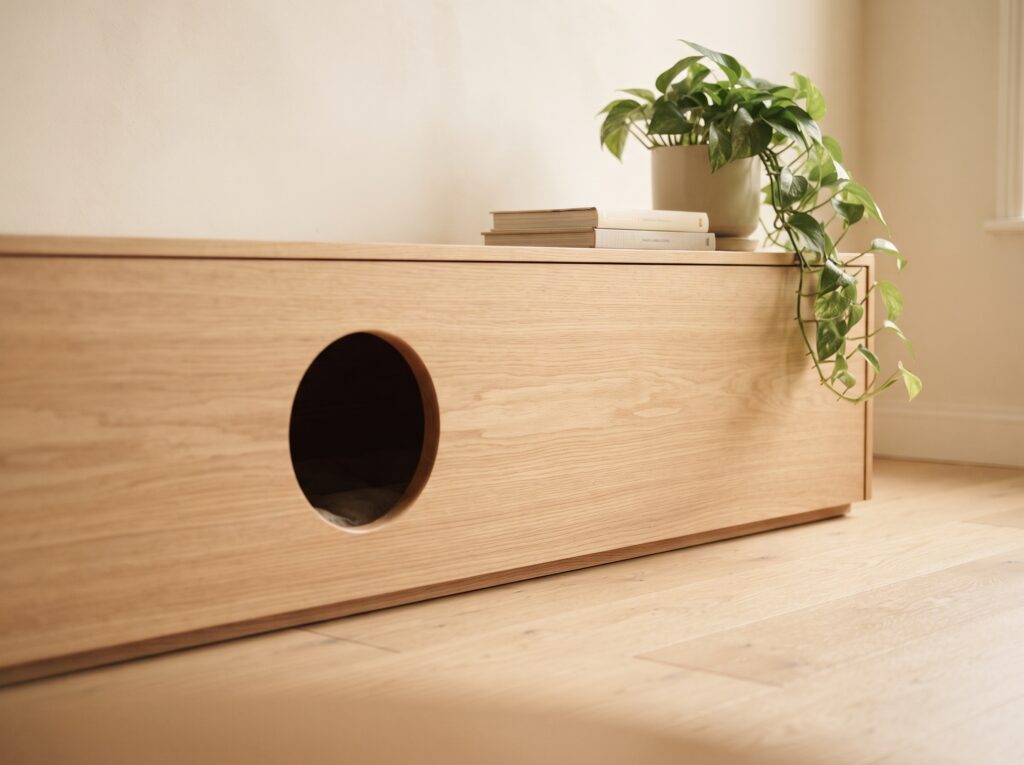
In a small flat there’s nowhere to put a litter box where it isn’t in a room you use. So the move is to stop trying to hide it and start disguising it.
A cabinet or side table with an entrance cut into the side does exactly that. From the outside it’s furniture. Inside it’s a litter box, with the tray contained so scatter stays in the cabinet rather than on your floor.
Two things to check: that the top actually lifts off or opens fully — some models only have the cat door, which makes cleaning miserable — and that the internal dimensions fit your actual tray, not a generic one.
This is the most expensive item on the list, and it’s the one that most changes how a small living room feels.
4. A litter trapping mat
Small flat, so the litter box is near where you live, so the litter it scatters is also near where you live.
A textured trapping mat catches what comes out on your cat’s paws and holds it until you shake it out. The double-layer kind — where granules fall through the top surface into a pocket underneath — works considerably better than a single flat mat.
Get one wider than you think. Cats leave the tray in whatever direction they feel like.
5. A wall-mounted scratcher
A floor scratching post costs you floor. A sisal board that mounts to the wall or a door doesn’t.
The height is the point: cats stretch fully when scratching vertically, and a wall-mounted board lets them do that without a base sitting in your room. It also protects the specific bit of wall or door frame they’ve already decided is theirs.
Mount it where they already scratch, not where you’d prefer they scratched. You’re redirecting a habit, not creating one.
Three more ideas that cost nothing

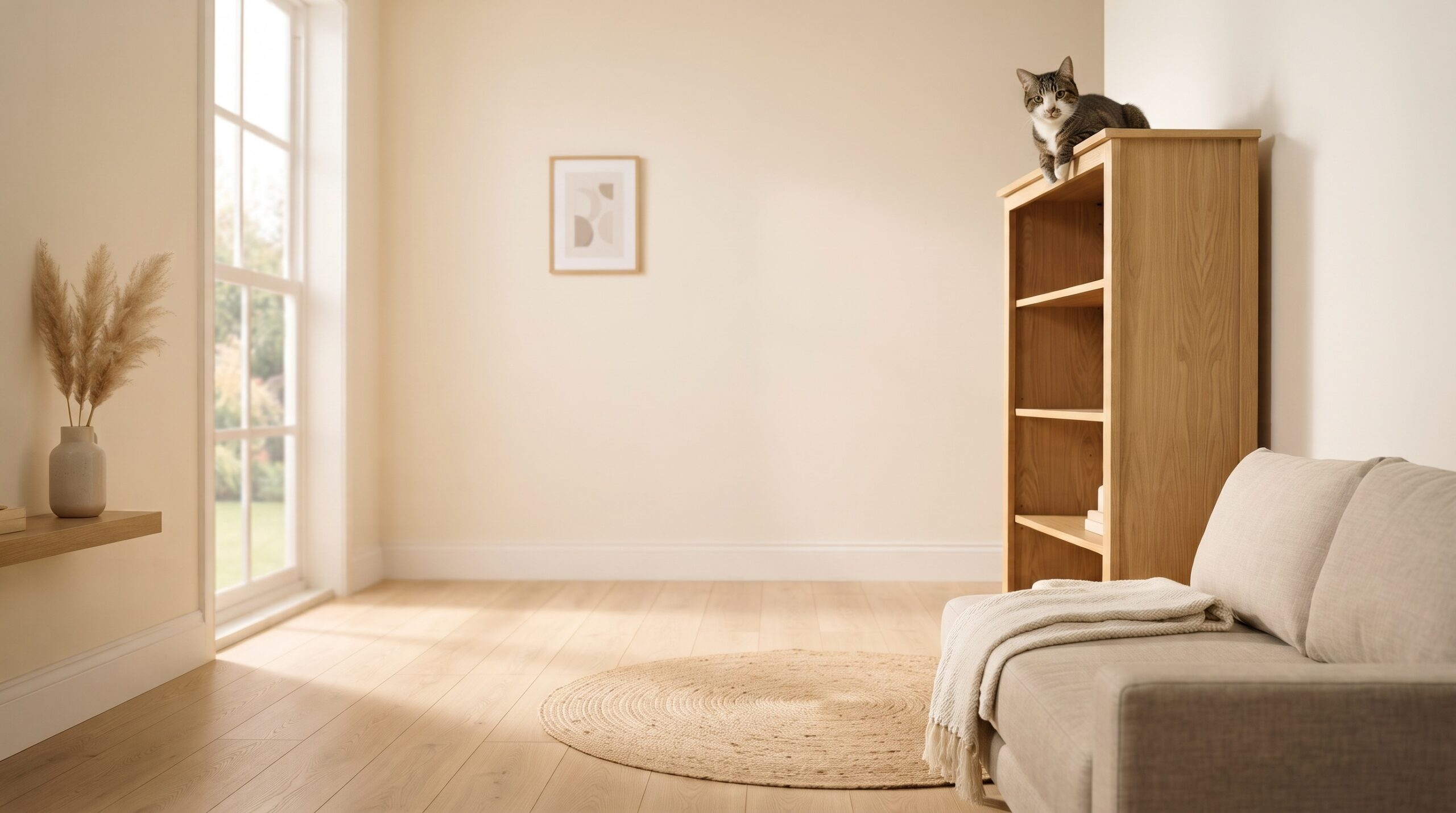
Clear the top of one bookcase. You have a perch already; it’s just currently covered in books and a plant. Cats overwhelmingly prefer the highest accessible surface in a room. Clearing one is free.
Move the litter box away from the food. Cats won’t eat next to a toilet, and in a small flat these end up close together by default. Even a couple of metres and a corner between them makes a measurable difference to how much cats use both.
Use the space under the bed properly. Not for the cat — for the cat’s supplies. Litter, food, spare toys, the carrier. Under-bed storage is the most underused volume in a small flat, and getting bulky supplies out of your cupboards buys you back the space you actually notice.
Five things I’d skip
Tall cat trees, floor-standing or floor-to-ceiling. I went looking for one to recommend here and kept running into the same thing: Amazon flags a striking number of them as frequently returned items. The pattern is consistent enough to take seriously, and the reasons are predictable — wobble after assembly, tension poles that slip, and shipping damage, all of which get worse the taller the thing is. Shelves fixed properly into a wall give you the same vertical territory with none of that, which is why they are the recommendation above.
Door-mounted cat towers. The appeal is obvious — vertical territory with no drilling — and for that reason I looked hard at the category before ruling it out. Every model I could find except one sits between 2.2 and 3.9 stars, most on fewer than fifty reviews. The single respectable option is flagged by Amazon as a frequently returned item, and its reviews say the same thing over and over: the cat won’t use it. Whether the cat takes to it is the most-discussed aspect of that product by a wide margin — ahead of price, ahead of assembly, ahead of everything.
That isn’t a manufacturing fault, it’s the design. The thing hangs on a door, and a door moves. Even five-star owners describe it as shaky. Cats test a surface before committing weight to it at height, and a platform that gives underfoot fails that test — which is also why straps loosening over time matters more here than it would on a floor-standing tree. Wall shelves work precisely because they don’t move. If drilling is genuinely out of the question, the window perch asks nothing of your cat’s confidence and costs a third as much.
Cat tunnels and floor-level play furniture. Fun, and cats do use them — but they consume floor space, which is exactly the resource you’re short of. In a bigger flat, sure. Not here.
Enclosed hooded litter boxes as a space solution. They don’t save space; they have the same footprint plus a lid. They also concentrate smell inside, which means you notice it less and your cat notices it more. If the goal is hiding the box, use furniture. If the goal is smell, clean it more often.
Multi-tier cat trees under about 120 cm. They occupy the footprint of a real cat tree while delivering height your cat could reach by jumping on the sofa. Either go properly tall or go wall-mounted; the middle is the worst of both.
Frequently asked questions
How many litter boxes do I need in a small flat? The standard guidance is one per cat plus one — so two boxes for one cat. In a genuinely small flat that’s often impractical, and one immaculately maintained box is better than two neglected ones. If you have two cats, though, find room for two. Resource competition around a single box is a common cause of going outside it.
Will wall shelves damage my rental? They need fixings, so yes, there will be holes. Filling and repainting a few anchor holes is normally accepted end-of-tenancy work, but check your agreement. If drilling is genuinely out, the window perch and a corner tree get you most of the vertical benefit with no fixings at all.
My cat ignores everything I buy. What am I doing wrong? Usually placement, not product. Cats use things that are on a route they already walk, near a view they already like, or in a spot they already sit. Watch where your cat actually goes for a few days, then put the thing there. A perch in the wrong corner will sit unused for years.
None of this makes a small flat bigger. What it does is stop the flat and the cat competing for the same square metres — and once you’ve built upwards, the room you get back is yours.
Related reading
- How to Keep a Litter Box From Taking Over Your Home
- How to Stop a Cat Scratching the Sofa
- 12 Pet Products That Actually Look Good in Your Home
Disclosure: As an Amazon Associate, I earn from qualifying purchases. Prices shown are approximate and change frequently; check the current price on Amazon.