Author: Matt

  • The New Dog Checklist: What You Actually Need in Month One

    Disclosure: As an Amazon Associate, I earn from qualifying purchases.

    The standard new dog shopping list contains about forty items. Most of them are wrong — not because the products are bad, but because you don’t yet know this dog. You don’t know how big the collar needs to be in three months, whether they’ll destroy soft toys, or whether they’ll sleep in the bed you chose.

    So here’s a shorter list: the things you genuinely need in the first four weeks, and the things worth waiting on.

    The principle: buy for the dog you have, not the one you imagine

    Almost every expensive first-month mistake comes from buying too early.

    Anything that has to fit — collar, harness, coat, crate — should be bought to current measurements, cheaply, and replaced. A puppy will outgrow the first two of everything. Buying “one they’ll grow into” produces something that doesn’t fit safely now.

    Anything about preference — bed, toys, treats — should wait until you’ve watched them for a fortnight. Dogs have opinions, and they don’t correlate with what looks good in a photo.

    Anything about a problem you don’t have yet — anti-bark devices, calming supplements, training gadgets — should wait until the problem appears. Most of them don’t.

    What’s left is a genuinely short list.

    Week one: the things you need on day one

    1. An engraved ID tag

    Order this before the dog arrives. It’s the item most likely to matter and the one most people leave for later.

    Your phone number, in the largest text that fits. Not the dog’s name — a stranger holding a lost dog needs a number. Add “MICROCHIPPED” underneath if there’s room.

    A new dog in a new home in the first fortnight is at the highest risk they will ever be of bolting. They don’t know where home is yet, and the recall isn’t built.

    What I’d buyGoTags Stainless Steel Engraved Pet ID Tag★★★★★★★★★★4.7105,000 reviews~$9

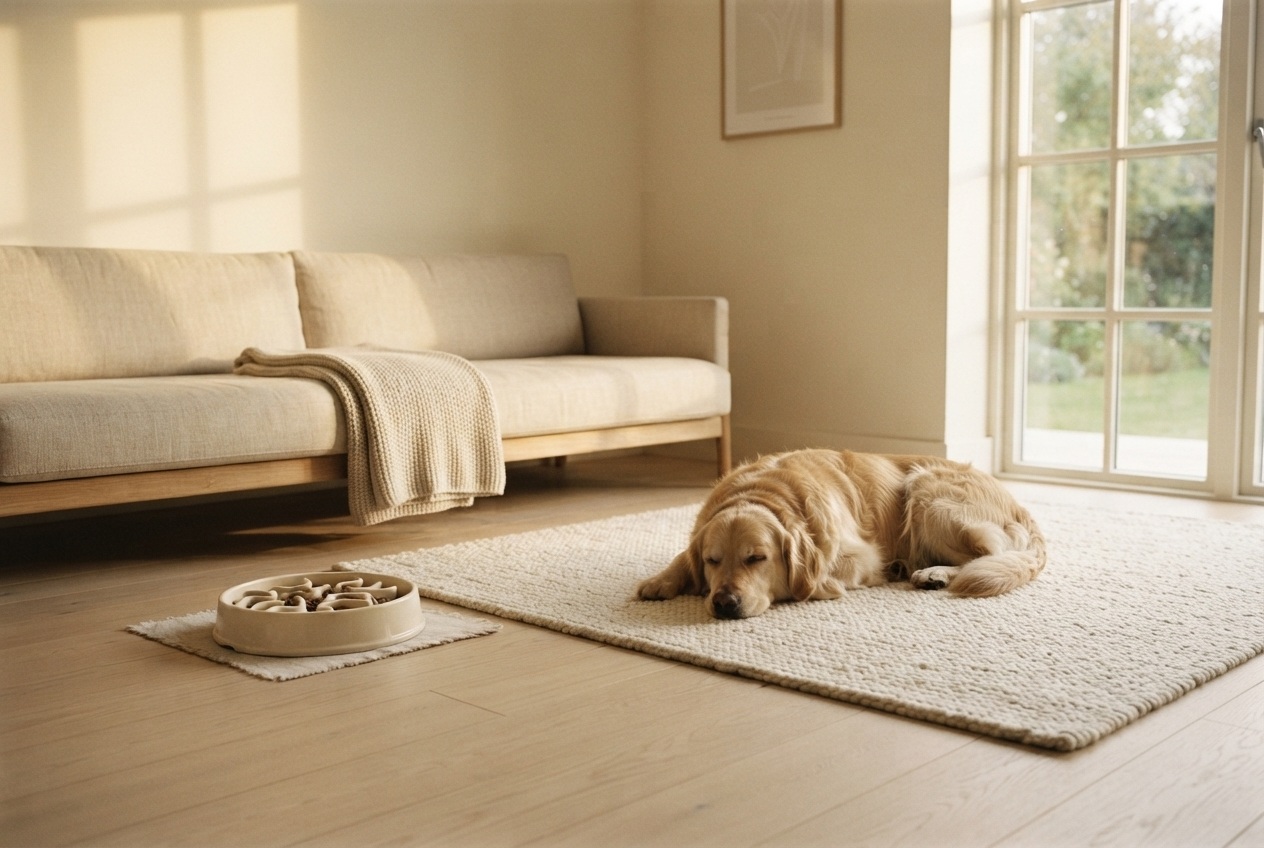
    2. A slow feeder bowl

    Two reasons this beats a normal bowl for a new dog.

    A dog in a new home eats fast — anxiety and uncertainty about whether more food is coming. A moulded maze stretches a thirty-second meal into five or ten minutes, which reduces gulping and the discomfort that follows.

    And it’s the cheapest introduction to the idea that food is something you work for, which underpins everything you’ll do with enrichment later.

    Match the maze depth to the nose. Flat-faced breeds need shallow, wide patterns.

    What I’d buyOutward Hound Fun Feeder Slo Bowl★★★★★★★★★★4.6136,000 reviews~$9

    3. A paw cleaner cup

    You will be doing a lot of short walks in the first month, in whatever weather there is, because that’s how a dog learns the neighbourhood.

    Twenty seconds per paw at the door saves your hallway, your rug, and eventually your sofa. It’s the cheapest floor-protection you’ll ever buy.

    Check the sizing against the paw, not the body weight.

    What I’d buyDexas MudBuster Paw Cleaner, Medium★★★★★★★★★★4.425,000 reviews~$10

    Weeks two to four: once you know the dog

    4. A lick mat

    Introduce this in week two, once they’ve settled enough to engage with something.

    It’s a textured silicone mat you spread something soft across — wet food, plain yoghurt, pumpkin. Licking is self-soothing and rhythmic, so it brings a dog down rather than winding them up.

    For a new dog that’s exactly the tool you want: it’s what you reach for when guests arrive, when there are fireworks, or when you need forty minutes to do something else. Freeze it to make it last.

    What I’d buyLUKITO Lick Mat with Suction Base, 2 Pack★★★★★★★★★★4.48,700 reviews~$9

    5. A snuffle mat

    By week three you’ll have discovered whether you have a high-energy dog. If you have, there are six more ways to tire one out indoors. If you do, this is the single most useful thing on the list.

    A mat of dense fabric strips you scatter dry food into. Fifteen minutes of nose-down searching settles a dog more reliably than an extra half-hour of walking — which matters enormously in a first month where you can’t yet do long walks, long absences, or the dog park.

    Start easy: food visible on top for the first few goes. A first experience that’s too hard puts some dogs off entirely.

    What I’d buyPET ARENA Adjustable Snuffle Mat★★★★★★★★★★4.38,000 reviews~$11

    6. A wall-mounted leash holder

    Not urgent, and I’d still buy it in month one, because the alternative is a habit that’s hard to break later.

    Leashes, harness, poo bags and treats all need one home by the door. Set that up while the routine is forming and it stays. Set it up in month six and you’re undoing four months of dumping things on a shelf.

    What I’d buyWall-Mounted Key Holder with 6 Hooks & Shelf★★★★★★★★★★4.7475 reviews~$27

    What to wait on

    The bed. Watch where they actually sleep for two weeks. A lot of dogs choose a corner, a doorway, or a spot with a view of the room, and the expensive bed in the wrong place gets ignored. Use a folded blanket until you know.

    Toys, beyond one or two. You don’t yet know whether you have a shredder, a chewer, a fetcher or a dog who ignores toys entirely. Buy one soft, one rubber, and watch.

    Treats in bulk. Sensitive stomachs are extremely common in the first month, partly from stress and partly from a diet change. Buy small until you know what agrees with them.

    Grooming equipment. Wait until the first shed to find out what coat you’re actually dealing with. A deshedding rake for a coat that doesn’t shed is money in a drawer.

    Frequently asked questions

    What about a crate? If you’re crate training, buy one sized to the adult dog with a divider panel, rather than buying twice. That’s the one exception to the “buy for now” rule, because the divider makes it adjustable.

    How soon should I start training? Immediately, but informally. The first fortnight is about the dog learning that you’re predictable and that good things come from you. Name, recall in the house, and settling. Formal sessions can wait; the relationship can’t.

    My new dog won’t eat. Should I worry? Reduced appetite in the first few days is very common and usually settles. If a dog eats nothing for more than about 24 hours, or there’s vomiting or diarrhoea alongside, that’s a vet call rather than a wait-and-see.


    The list above comes to well under a hundred and fifty dollars, which is a fraction of what the standard new-dog haul costs — and the difference isn’t frugality. It’s that the money you don’t spend in week one is money you can spend in month three on the things this particular dog turns out to need.


    Disclosure: As an Amazon Associate, I earn from qualifying purchases. Prices shown are approximate and change frequently; check the current price on Amazon.

  • How to Stop a Cat Scratching the Sofa (Without a Spray Bottle)

    Disclosure: As an Amazon Associate, I earn from qualifying purchases.

    In twenty-five years of living with cats I have lost exactly one sofa, and it was entirely my fault. I bought a scratching post, put it in the corner of the room where it looked tidiest, and then wondered why the cat kept using the arm of the sofa instead.

    The mistake is almost universal, and once you understand it the problem becomes much more solvable than it looks.

    Why cats scratch, and why it isn’t naughtiness

    Scratching does three things at once, and none of them are about sharpening claws in the way people assume.

    It’s a stretch. Watch a cat scratch and they extend the whole body, shoulder to hip. It’s the feline equivalent of a full-body reach after sleeping.

    It sheds the outer claw sheath. The old layer flakes off. That’s the “sharpening” part, and it’s maintenance rather than weapon-making.

    It’s a territorial marker. There are scent glands in the paw pads, and a scratched surface carries a visual mark and a chemical one. This is the part that explains everything about location.

    Because scratching is territorial signalling, cats scratch where the signal counts: on the route through the room, near where they sleep, and at the entrance to a space. A sofa arm sits exactly at those coordinates. A post in the corner does not.

    That’s the whole problem. Not the post, not the cat — the map.

    The rule that fixes most of it

    Put the scratcher where the cat is already scratching. Not where you’d prefer it. Not where it looks tidy.

    If the cat is doing the arm of the sofa, the scratcher goes beside the arm of the sofa. It looks silly for a few weeks. You can move it gradually — a few inches a week — once the habit has transferred, and most cats will follow it. Move it too early and they go back to the sofa.

    Three secondary rules that matter almost as much:

    It has to be tall enough to stretch on. Roughly 80 cm minimum for an adult cat. The very common short posts are too short to be worth using; the cat can’t get the stretch, so the sofa still wins.

    It has to be rigid. If it wobbles, it’s rejected. Cats put real weight through a scratch, and an unstable post is unpleasant and slightly alarming.

    Cats have a texture and orientation preference. Some are vertical scratchers, some horizontal. Some want sisal rope, some want cardboard, some want carpet. Watch which surface yours has chosen and buy that.

    What to buy

    1. A tall, rigid sisal post

    The default and the one to start with, provided you get the height right.

    Look for at least 80 cm of scratchable surface — not total height including a platform — and a base wide and heavy enough that it doesn’t rock when pushed hard at the top. Sisal rope wound around a post lasts considerably longer than sisal fabric.

    If your flat is short on floor space, look for a slim design or a corner unit rather than one with a wide sprawling base.

    What I’d buyAmazon Basics Sturdy Cat Scratching Post★★★★★★★★★★4.59,200 reviews~$37

    2. A wall-mounted sisal board

    The zero-footprint option, and the one I’d suggest if the cat’s chosen spot is a wall, a door frame, or the side of a bookcase.

    Mounted at full stretch height it gives the vertical extension a post does, without a base in the room. It also lets you put the scratcher precisely where the cat has decided the territory marker belongs, which a freestanding post can’t always manage.

    Mount it slightly higher than you think — measure your cat stretched up against the wall.

    What I’d buy34″ Wall-Mounted Sisal Cat Scratcher★★★★★★★★★★4.6598 reviews~$27

    3. A horizontal cardboard scratcher

    Cheap, and worth buying even if you already have a post, because it costs almost nothing to test which orientation your cat prefers.

    A lot of cats are horizontal scratchers and their owners have never found out, because every product marketed at them is a vertical post. If your cat scratches the carpet or the rug rather than furniture, this is the one you need.

    They’re consumable. A well-used one lasts a few months. Buy the double-sided kind and flip it.

    What I’d buyZOMISIA Double-Sided Cardboard Scratcher Lounge★★★★★★★★★★4.6589 reviews~$23

    4. Furniture protectors, as a temporary measure

    Clear vinyl panels that pin to the corner of a sofa.

    I want to be honest about these: they work, and they are ugly. They’re a bridge, not a solution — you use them for the weeks while the new scratcher is establishing itself, then take them off. Left on permanently they just move the problem to a different piece of furniture.

    Get the ones with twist pins rather than adhesive. Adhesive backing on upholstery is a bad idea.

    What I’d buyFixZilla Cat Scratch Furniture Protector, 10-Pack★★★★★★★★★★4.48,400 reviews~$20

    5. Catnip or silvervine, to make the new post the interesting one

    The transfer goes faster if the scratcher is genuinely more attractive than the sofa, and this is the cheapest way to tilt it.

    Rub it into the sisal rather than sprinkling it on. Reapply weekly for the first month — the scent fades fast and the association needs repeating.

    Worth knowing: roughly a third of cats don’t respond to catnip at all; it’s hereditary. If yours is one of them, silvervine works on many catnip-immune cats and is worth trying instead.

    What I’d buyPotaroma Natural Silvervine Sticks★★★★★★★★★★4.36,800 reviews~$7

    Three things I’d skip

    Spray bottles, and punishment generally. Twenty-five years and I have never seen this work — the same twenty-five years behind what I’d tell anyone about litter boxes. What it teaches is that you are unpredictable — the cat learns to scratch the sofa when you’re not in the room, and separately becomes warier of you. You’ve kept the behaviour and lost some trust.

    Anti-scratch sprays that claim to repel. Occasionally one works on one cat. Mostly they don’t, and the ones that do work fade within days. Redirecting to a better option beats trying to make the sofa unpleasant.

    Declawing. It’s an amputation of the last bone of each toe, not a nail trim. It’s banned or restricted in much of the world, and it’s associated with long-term pain and litter box avoidance. If someone suggests it, the answer is no.

    Frequently asked questions

    How long does it take to redirect a cat? Usually two to four weeks with the scratcher in the right place, faster with catnip. If nothing has changed after a month, the location, the height or the texture is wrong — change one variable at a time.

    Should I trim my cat’s claws? It helps, and it reduces damage when scratching does happen. Every couple of weeks, just the sharp translucent tip, well clear of the pink quick. It doesn’t remove the urge to scratch, so it’s a supplement rather than a fix.

    My cat suddenly started scratching much more. Why? Sudden increases in territorial marking often follow a change: a new pet, a house move, a new person, building work next door, or a strange cat visible through a window. Worth looking for the trigger rather than only treating the symptom.


    The sofa I lost was replaced by a post placed forty centimetres from where the damage had been, with catnip rubbed into the rope. It took about three weeks. Nothing about the cat changed — I just finally put the thing where she had been telling me to put it all along.


    Disclosure: As an Amazon Associate, I earn from qualifying purchases. Prices shown are approximate and change frequently; check the current price on Amazon.
  • How to Keep a Litter Box From Taking Over Your Home

    How to Keep a Litter Box From Taking Over Your Home

    Disclosure: As an Amazon Associate, I earn from qualifying purchases.

    I’ve lived with cats for over twenty-five years — twelve of them, at various points — and the litter box is the one problem that never fully goes away. If space is the constraint rather than smell, the small-space cat guide covers the vertical side of it. It just becomes better or worse managed.

    Most advice about it is about smell. Smell is real, but it’s a symptom. The actual problems are three: the box is in a room you use, the litter travels, and the whole arrangement announces itself. Fix those and the smell mostly takes care of itself.

    Start with the things that cost nothing

    Before buying anything, two changes do more than any product.

    Scoop daily, not every other day. This is unglamorous and it is the entire answer to smell. A box scooped every morning does not smell. A box scooped every second day does, and no amount of deodorising litter, charcoal filter, or air freshener changes that — those things mask a problem that takes ninety seconds to remove.

    Move the box away from the food. Cats are strongly averse to eating near a toilet, and in a small flat these two things end up close together by default. Even a couple of metres and a corner between them measurably improves how willingly a cat uses both.

    The related rule, if you have more than one cat: one box per cat, plus one. Two cats want three boxes. In a small flat that’s often impractical, and one immaculately maintained box beats two neglected ones — but resource competition around a single box is one of the most common causes of a cat going elsewhere.

    1. Furniture that hides the box

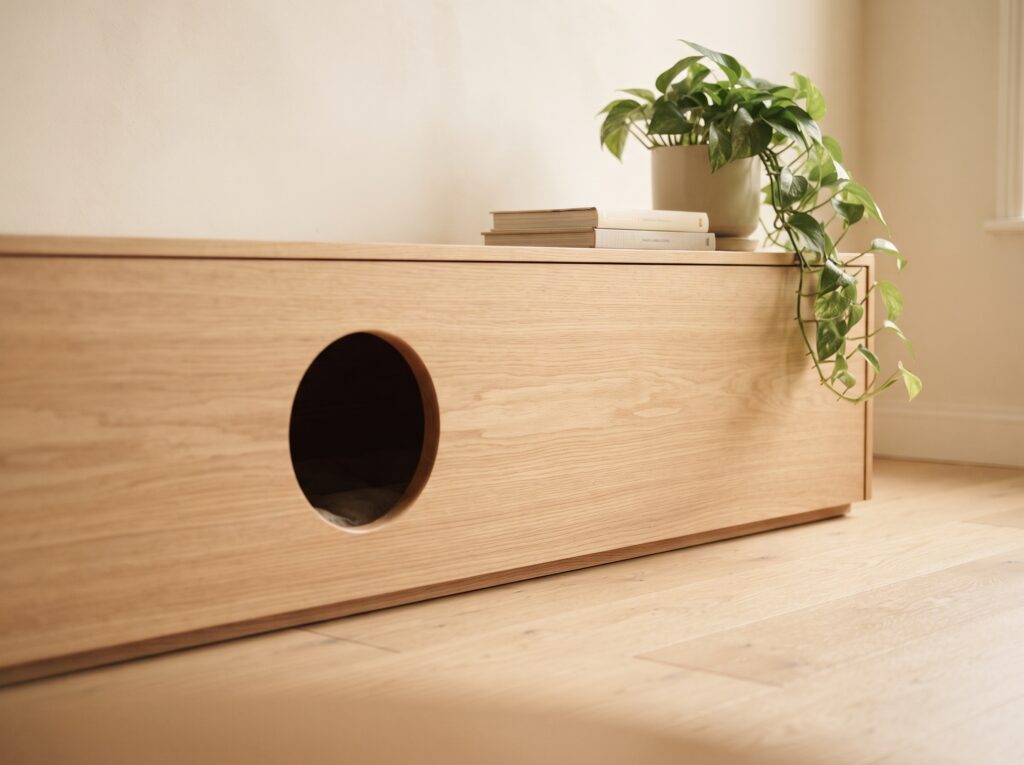
    An oak litter cabinet that reads as a sideboard, with a cat leaving through the opening in its side

    The single change that most alters how a room feels.

    A cabinet or side table with an entrance cut into the side reads as furniture from the outside and contains a litter tray inside. The scatter stays in the cabinet rather than on your floor, and visitors don’t clock what it is.

    Two things to check before buying:

    The top must open fully, not just the cat door. Some designs only have the entrance, which turns cleaning into an exercise in contortion, and a box that’s annoying to clean is a box that gets cleaned less.

    Measure the interior against your actual tray. Listings quote external dimensions. The internal space is often considerably smaller than the photo suggests.

    What I’d buyHzuaneri Cat Litter Box Enclosure Cabinet★★★★★★★★★★4.6967 reviews~$85

    2. A double-layer trapping mat

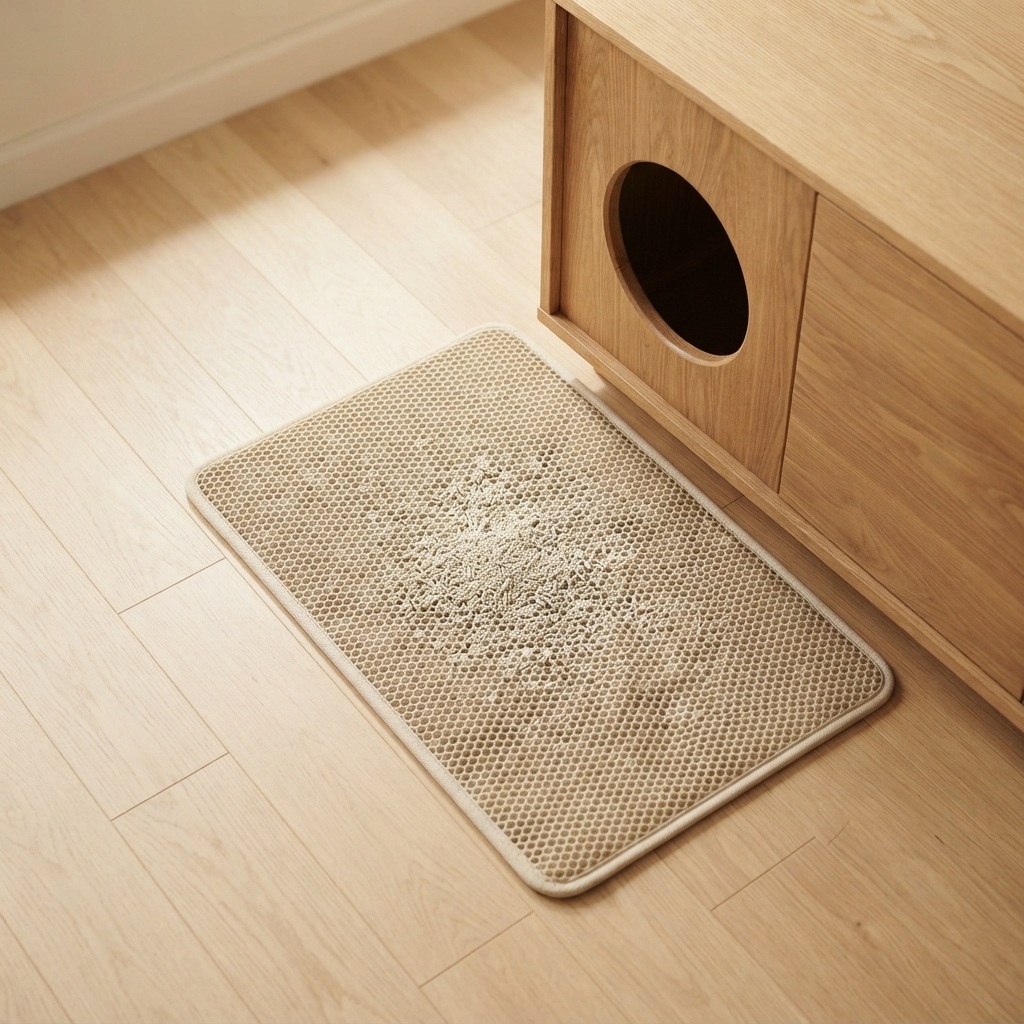
    A two-layer litter mat trapping granules in the pocket beneath its top surface

    Litter travels on paws and gets everywhere. A mat catches it.

    The double-layer kind works noticeably better than a flat one: granules fall through holes in the top surface into a pocket underneath, so they’re trapped rather than sitting on top waiting to be kicked further. Empty it by lifting one edge into the bin.

    Buy it wider than you think. Cats leave the tray in whatever direction they feel like, and a mat that only covers the front does half a job.

    What I’d buyPieviev Double-Layer Cat Litter Mat★★★★★★★★★★4.474,000 reviews~$14

    3. A high-sided open tray

    A high-sided cream litter tray with a low entry cut-out standing in a bright laundry corner

    The single biggest cause of litter on the floor isn’t tracking on paws — it’s cats who dig enthusiastically and fling it over the side.

    A tray with high sides and a lower entry cut-out solves that without enclosing the cat. Look for something like 20 cm of wall height at the back with a dip at the front for easy entry, especially if your cat is older or arthritic.

    Bigger than you think, again. The general guidance is a tray about one and a half times the cat’s length, and most trays sold are smaller than that.

    What I’d buyAmazon Basics Large High-Sided Litter Box★★★★★★★★★★4.39,200 reviews~$23

    4. A decent scoop and a lidded bin

    This sounds like an afterthought and it isn’t.

    The reason people scoop every other day instead of daily is friction: a flimsy scoop, and nowhere to put the waste. Fix both and the daily habit sticks — which, as above, is the whole ballgame for smell.

    A metal or heavy-duty plastic scoop with the right slot width for your litter, and a small lidded bin beside the box so the waste doesn’t travel through the flat to the kitchen. Together they turn a two-minute job into a twenty-second one.

    What I’d buyAluminium Alloy Cat Litter Scoop★★★★★★★★★★4.818,000 reviews~$8

    5. An air purifier, if you’ve done everything else

    Worth saying clearly: this is not a substitute for scooping. If the box smells, the box needs cleaning.

    Where a purifier does help is the residual ambient smell in a small flat where the box is unavoidably in the living space — the background note rather than the acute problem. A unit with an activated carbon layer, not just HEPA, is what handles odour; HEPA alone deals with particles.

    Match the room size, and remember the carbon filter is a consumable.

    What I’d buyMOOKA Air Purifier with Activated Carbon★★★★★★★★★★4.59,400 reviews~$80

    The one reason to keep looking in the box

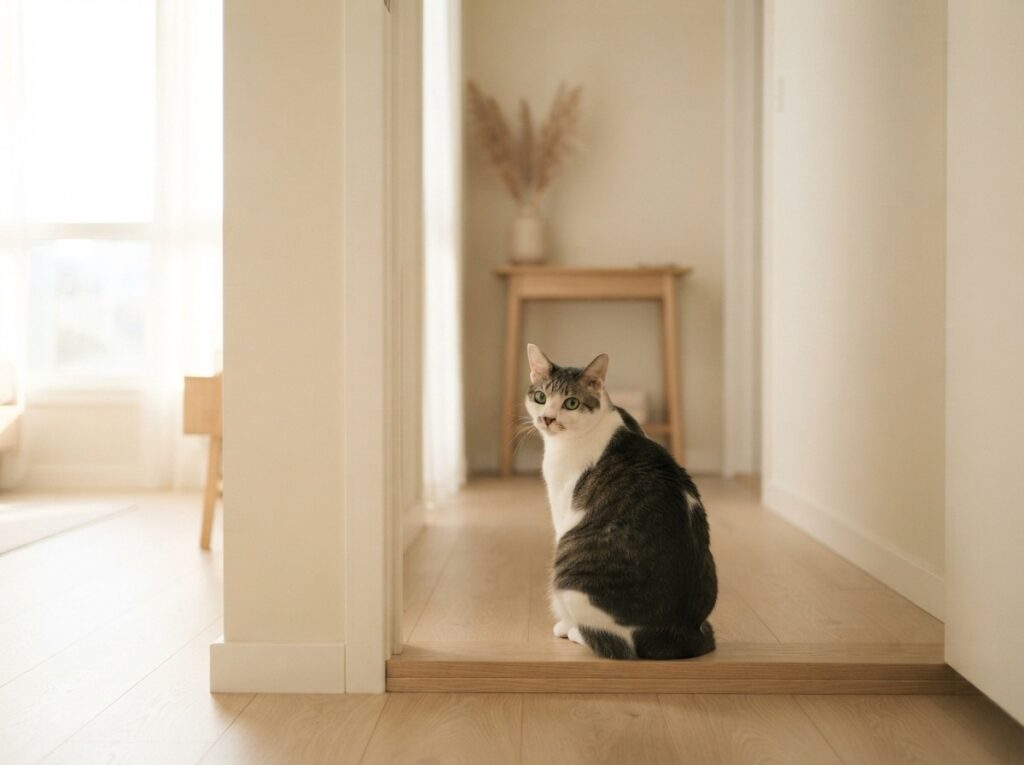
    A cat sitting in a doorway in morning light, the moment before you check the box

    Everything above is about making a litter box less visible. This section is the opposite: however well you hide it, keep looking inside it.

    Cats are extremely good at concealing illness. It isn’t stoicism — it’s instinct. A cat that shows weakness in the wild is a cat that gets picked off, so the behaviour is to carry on as normal for as long as possible. Dogs sulk, whine, and go off their routine early. Cats don’t. By the time something is visible from the outside, it has usually been going on for a while.

    The litter box is one of the few places that reports on a cat before the cat does.

    What to notice — in either direction. Clumps suddenly much larger, or much smaller. More trips, or fewer. Long sits with nothing produced. A change in stool consistency that lasts more than a couple of days. You don’t need to measure anything. You need to know what normal looks like for your cat, so that not-normal registers.

    A useful threshold: a sustained change of roughly a third, held for two to three days, is worth a phone call.

    Coat is the other one. A coat that turns dull, dry, or unkempt often means the cat has stopped grooming properly — and cats stop grooming when something hurts or when they feel unwell. It’s not a cosmetic problem.

    And the part no product solves. There is nothing on this page, or on any page like it, that prevents kidney disease. Chronic kidney disease affects 30–40% of cats over ten and around 80% of cats over fifteen, and two-thirds of kidney function is typically gone before any sign shows. A water fountain may help some cats drink a little more. It is not a substitute for a blood panel.

    If your cat is seven or older, ask your vet for a baseline blood and urine test at the next visit, and repeat it yearly. That test is the only thing on this list that finds the problem while it can still be slowed.

    I learned this the expensive way, with a fourteen-year-old cat and two months of small signs I explained away.

    Three things I’d skip

    Hooded litter boxes. They’re the standard advice and I think they’re mostly wrong. They don’t save floor space — same footprint plus a lid — and they concentrate the smell inside, which means you notice it less and the cat notices it considerably more. Cats who suddenly stop using a box often turn out to be avoiding a hood.

    Scented litter and deodorising crystals. Cats have a far stronger sense of smell than we do, and a heavily perfumed litter is genuinely aversive to some of them. What smells clean to you can be the reason a cat starts going behind the sofa.

    Self-cleaning boxes, at the budget end. The premium ones work. The cheap ones jam, and a jammed automatic box is worse than a manual one because you stop checking it. If you’re not going to spend properly here, don’t spend at all.

    Frequently asked questions

    How often should I change the litter completely? With clumping litter and daily scooping, a full change every two to four weeks is typical. Wash the tray with unscented soap and hot water when you do — not bleach, and not anything ammonia-based, which smells like urine to a cat.

    My cat has started going outside the box. What first? Vet first, before anything else. Sudden litter box avoidance is a very common early sign of urinary tract problems, and it’s genuinely urgent in male cats. Once medical causes are excluded, then look at box cleanliness, location, litter type and competition between cats — in that order.

    Is covered furniture bad for the cat, like a hood? Less so, and the reason is volume. A cabinet is a small room with an open doorway; a hood is a box on your head. Cats generally accept furniture enclosures that have room to turn around and a clear exit. If yours doesn’t, take the door off the cabinet and see if that fixes it.


    Nothing here makes a litter box invisible. What it does is stop it being the defining feature of the room it’s in — and after twenty-five years, the thing I’d tell anyone starting out is that the ninety seconds each morning matters more than everything else on this list combined.


    Disclosure: As an Amazon Associate, I earn from qualifying purchases. Prices shown are approximate and change frequently; check the current price on Amazon.

  • Gifts for Dog Owners That Won’t End Up in a Drawer

    Disclosure: As an Amazon Associate, I earn from qualifying purchases.

    There is a specific category of gift that dog owners receive constantly and use approximately never. A mug with a paw print. A sign saying the dog runs this house. A t-shirt about being a dog mom. All bought with genuine affection, all in a drawer by March.

    The problem is that these gifts are about the idea of owning a dog rather than the daily reality of it. And the daily reality is where the useful gifts live.

    Here’s what actually gets used, roughly in order of how likely it is to be kept.

    The test: does it solve a Tuesday?

    Ask yourself whether the thing would make an ordinary Tuesday slightly better. Not a birthday, not a photo, not a special occasion — a wet Tuesday in November when the dog needs walking and nobody wants to go.

    Gifts that pass that test get used daily and remembered. Gifts that don’t become clutter, however thoughtful the intention.

    Two secondary rules:

    Don’t buy anything that has to fit. Collars, harnesses, coats and beds all depend on measurements and preferences you don’t have. A gift that needs returning isn’t a gift.

    Don’t buy food or treats unless you know the dog’s diet. Allergies and sensitive stomachs are extremely common, and a bag of treats that can’t be used is worse than nothing.

    1. An engraved ID tag

    Small, cheap, and the item most likely to matter one day.

    Most dogs are wearing a tag that has worn illegible, or one that was never engraved deeply enough. A new deep-engraved metal tag with the owner’s phone number in large text is the sort of thing nobody buys for themselves until they need it.

    Get the number engraved, not the dog’s name — a stranger holding a lost dog needs a number, not a name. It’s a fifteen-dollar gift that quietly does a serious job.

    What I’d buyGoTags Stainless Steel Engraved Pet ID Tag★★★★★★★★★★4.7105,000 reviews~$9

    2. A custom pet portrait

    The one genuinely sentimental gift that doesn’t end up in a drawer.

    Commissioned illustrations of someone’s dog — watercolour, line drawing, minimal print — get framed and hung, which is more than can be said for almost any other pet-themed gift. The reason is that it’s about their dog rather than dogs in general.

    You send a photo, the artist sends back artwork. Prices range from about twenty dollars for a simple digital piece up to a few hundred for something elaborate; the mid-range is usually the sweet spot.

    Order earlier than you think. Custom work has a turnaround, and rushing it defeats the point.

    If you’d like to commission one, I’ve written about where to find pet portrait artists — the marketplaces are worth knowing about because quality varies a lot.

    3. A lick mat

    An odd-looking gift that gets used more than almost anything else on this list.

    It’s a textured silicone mat you spread something soft across — yoghurt, wet food, pumpkin. The dog licks at it for ten or fifteen minutes, and licking is a self-soothing behaviour, so it settles them rather than winding them up.

    For the recipient this is the gift of forty minutes of quiet, which is why it stays in use long after the novelty gifts have gone. Freeze it and it lasts even longer.

    Under fifteen dollars, and works for essentially every dog.

    What I’d buyLUKITO Lick Mat with Suction Base, 2 Pack★★★★★★★★★★4.48,700 reviews~$9

    4. A wooden leash holder with a shelf

    The kind of thing people want but don’t get round to buying.

    Almost every dog household has leashes hanging on a door handle or dumped on a shelf. A wall-mounted wooden rail fixes it permanently, looks like furniture, and the versions with a small shelf absorb the keys, poo bags and torch that otherwise migrate into coat pockets.

    It’s a gift that improves an entryway rather than adding to it, which is unusual for pet gifts.

    What I’d buyWall-Mounted Key Holder with 6 Hooks & Shelf★★★★★★★★★★4.7475 reviews~$27

    5. A microfibre drying towel — two of them

    Unglamorous and enormously useful.

    Every dog owner is currently using a decrepit bathroom towel that has been on the same hook since spring and is starting to smell. Microfibre holds several times its weight in water and dries fast enough not to go sour between walks.

    Buy two, so one can be in the wash. A single towel is a half-gift.

    What I’d buyBone Dry Microfiber Pet Grooming Towel★★★★★★★★★★4.511,000 reviews~$14

    6. A snuffle mat

    If the person has a young or high-energy dog, this is the gift they’ll thank you for specifically.

    It’s a mat of dense fabric strips that you scatter dry food into, so the dog has to nose through it to find dinner. Fifteen minutes of that settles a dog more reliably than an extra half hour of walking, which is a genuinely useful thing to hand someone in the middle of a rainy week.

    Get a washable one. Dry food leaves oils in fabric.

    What I’d buyPET ARENA Adjustable Snuffle Mat★★★★★★★★★★4.38,000 reviews~$11

    What I’d avoid

    Anything with a slogan. “Dog mom”, “my kids have paws”, “the dog runs this house”. These are worn once, photographed, and retired. If the person wanted one, they have one.

    Novelty mugs and signs. Same problem, plus they take up permanent shelf space in someone else’s home.

    Toys, unless you know the dog. Dogs have strong and unpredictable preferences, and a destructive chewer given a soft toy produces stuffing everywhere within a minute. If you must buy a toy, buy a puzzle feeder rather than a plush.

    Anything perishable. Treats, chews, dental sticks — all depend on a diet you probably don’t know.

    Frequently asked questions

    What’s a good gift under $20? An engraved ID tag or a lick mat. Both are genuinely useful, neither requires knowing anything about the dog’s size or diet.

    What about a gift for someone who just got a puppy? A snuffle mat and a lick mat together. New puppy owners are chronically short of ways to occupy a puppy indoors, and they usually haven’t discovered either yet.

    Is it worth spending more than $50? Only for a custom portrait. Above fifty dollars, most pet gifts are furniture — beds, crates, feeding stations — and those depend on the home and the dog’s habits. Better to spend less on something useful than more on something that has to fit.


    The reliable pattern is that the best pet gifts aren’t really about the pet. They’re about making the owner’s week slightly easier — which, if you’ve ever been the person standing in the rain at half six in the morning, is a more affectionate gesture than a mug.


    Disclosure: As an Amazon Associate, I earn from qualifying purchases. Prices shown are approximate and change frequently; check the current price on Amazon.
  • How to Never Lose Your Dog: 4 Low-Tech Fixes

    Disclosure: As an Amazon Associate, I earn from qualifying purchases.

    Most advice about lost pets is about what to do afterwards — the flyers, the Facebook groups, the walking around calling their name at midnight. Useful, and I hope you never need it.

    This is about the hour before. Four things you can set up now that make a dog far easier to get back, none of which require a subscription and none of which cost more than about thirty dollars.

    What actually gets a dog home

    It’s worth being clear about how a lost dog is usually recovered, because it changes what’s worth buying.

    Most dogs are found by a person, not by technology. Someone sees a loose dog, gets close enough to catch it, and then looks for a way to contact you. The bottleneck in that chain is almost never locating the dog. It’s the last step — a stranger, holding your dog, trying to work out who to call.

    That means the highest-value thing you own is the thing that stranger can read in ten seconds without any equipment: a tag with a phone number on it.

    Microchips matter too, but a chip requires the finder to take the dog to a vet or shelter to be scanned, which adds hours or days. A legible tag closes the loop immediately.

    Trackers are genuinely useful — but for a specific case: the dog that ran off in a place with no people, where nobody will find them for you.

    So the order of priority is: tag first, tracker second, visibility third.

    1. An engraved ID tag

    The cheapest item here and the one that recovers the most dogs.

    Put your phone number on it, in the largest text that fits. Not the dog’s name — a stranger doesn’t need it, and there’s a reasonable argument that a name makes it easier for someone to call the dog away from you. Number first, and “MICROCHIPPED” underneath if there’s room.

    Buy the deep-engraved metal kind, not the stamped or printed ones. A tag that’s worn illegible is a tag that doesn’t work, and the printed ones wear through in about a year of scraping against a collar buckle.

    Buy two while you’re at it — one for the collar, one for the harness. Dogs escape from whichever one they happen to be wearing.

    What I’d buyGoTags Stainless Steel Engraved Pet ID Tag★★★★★★★★★★4.7105,000 reviews~$9

    2. An AirTag holder — not a subscription tracker

    If you’re going to use a tracker, the case for the AirTag-style approach is strong for most owners: no monthly fee, and it works off the enormous network of other people’s phones passing nearby.

    The trade-off is real and worth stating. It only reports a location when someone else’s phone comes within Bluetooth range. In a town that’s constant. On an empty hillside it’s useless, and a GPS tracker with a cellular subscription is genuinely better for that case.

    For a dog that gets loose in populated places — which is most dogs — the free option is the right one.

    Buy a proper holder rather than a keyring loop. Look for a silicone or reinforced case that fully encloses the tracker and threads onto the collar strap itself. Anything dangling on a ring gets snagged, and anything not enclosed gets chewed out.

    What I’d buyElevation Lab AirTag Dog Collar Holder★★★★★★★★★★4.75,600 reviews~$17

    3. A rechargeable light-up collar

    Half of all dog walks in winter happen in the dark, and a dark-coated dog at twenty metres is invisible.

    This does two jobs. It keeps you able to see your own dog off-lead at dusk, which prevents a lot of “where did they go” moments before they become anything. And if a dog does get loose at night, a moving light is visible from a distance that a torch sweep will never cover.

    Get the rechargeable kind rather than button-cell — you’ll actually keep it charged, whereas a battery one dies and stays dead. Check it’s rated for rain, and get it in a size that fits over or alongside the collar without competing with the tag.

    What I’d buyBSEEN Rechargeable LED Dog Collar★★★★★★★★★★4.617,000 reviews~$13

    4. A properly fitted harness with a back-up point

    A surprising share of lost dogs didn’t escape a garden. They backed out of a collar on the pavement, usually while startled.

    A well-fitted Y-front harness is much harder to reverse out of than a collar, and the double-clip kind — one ring at the chest, one at the back — gives you a second point of contact if one fails.

    Fit is the whole product here. Two fingers under any strap, no more. Measure the chest at its widest point rather than trusting a breed-based size chart, which is close to meaningless given how much dogs vary.

    And keep the ID tag on the collar even when the harness is on. Harnesses come off at home; collars mostly don’t.

    What I’d buyrabbitgoo Escape-Proof Dog Harness★★★★★★★★★★4.46,000 reviews~$37

    The free things that matter more than any of it

    Get the microchip registration updated. A very large share of registered chips have an out-of-date phone number attached. It takes five minutes on the registry’s website and it is the single highest-value thing in this article. Do it today.

    Take a clear photo, from the side, in daylight. If you ever need to make a poster, you’ll want a photo that shows markings clearly. The photos on your phone are almost all of your dog’s face from above, which is nearly useless for identification.

    Know your dog’s escape mode. Some bolt at noise. Some follow a scent and don’t hear you. Some go through gates the second they’re opened. The prevention that works is specific to which one yours is.

    Two things I’d skip

    GPS trackers with monthly subscriptions, for the average dog. They work, and if you hike in remote areas or have a genuine bolter they’re worth every penny. But for a dog that lives in a town and might get loose near people, you’re paying $5–15 a month for coverage the free option already provides.

    Tags with the dog’s name in large text and the number small. This is the standard design and it’s backwards. The name is decorative. The number is the product.

    Frequently asked questions

    Should I put my address on the tag? Most people shouldn’t. A phone number is enough to reunite you, and a tag showing your address tells a stranger where you live and, implicitly, that your dog isn’t home. Number and “MICROCHIPPED” is the useful combination.

    Is a tracker worth it if my dog has never run off? The honest answer is that it depends on where you’d lose them. Town and suburbs, an AirTag-style tag plus a good ID tag covers it. Remote countryside, a subscription GPS is a different proposition. Don’t buy the expensive one for a risk you don’t have.

    How often should I check the tag? Once a month, glance at it. Tags wear against buckles and go illegible gradually enough that you stop noticing. If you can’t read it at arm’s length, replace it.


    None of this takes an afternoon. A tag, a tracker holder, a light, and five minutes updating a microchip record — and the version of the evening where a stranger picks up your dog and calls you within ten minutes becomes much more likely than the other one.


    Disclosure: As an Amazon Associate, I earn from qualifying purchases. Prices shown are approximate and change frequently; check the current price on Amazon.
  • 12 Pet Products That Actually Look Good in Your Home

    12 Pet Products That Actually Look Good in Your Home

    Disclosure: As an Amazon Associate, I earn from qualifying purchases.

    There is a particular aesthetic to pet ownership that nobody signs up for. Bright blue plastic. A food bowl with a cartoon paw print. A bed in a shade of beige that exists nowhere else in nature. Individually they’re fine. Collectively they turn a living room into a waiting area.

    The odd thing is that it isn’t necessary. Almost every category of pet product now has a version made of wood, ceramic, seagrass or metal, at roughly the same price as the plastic one. You just have to know it exists, because the plastic version is what gets shown to you first.

    Here are the swaps that make the most difference, roughly in order of how much visual space they take back.

    The principle: match the room, not the pet

    The instinct when buying pet things is to look at the pet aisle. That’s the mistake. The pet aisle is organised around pets, so everything in it announces itself as pet equipment.

    A more useful question is what the object is, structurally. A raised food bowl is a small table. A toy basket is a basket. A litter box cabinet is a side table with a hole in it. Once you see it that way, you can shop in furniture and homeware instead, where the material choices are better and the design brief is “belong in a room.”

    Two rules that hold up:

    Natural materials read as furniture; plastic reads as equipment. Wood, ceramic, seagrass, rattan, metal. The pet item stops being a pet item the moment it’s made of something your other furniture is made of.

    Match what’s already in the room. If your flat is warm wood tones, get warm wood. If it’s white and grey, get ceramic and metal. A beautiful object in the wrong palette is still visual noise.

    1. A woven toy basket

    A woven seagrass basket filled with dog toys in a bright living room corner

    The single biggest visual win, because toys are the thing that spreads.

    A seagrass or rattan basket with handles reads as storage — the kind of thing you’d own anyway. Put it at the edge of the room where the toys already end up, and the floor stays clear.

    Get one taller than you think you need, and with a flat base so it doesn’t tip when a dog goes shoulder-deep looking for a specific toy.

    What I’d buyDeco 79 Seagrass Storage Basket, Large★★★★★★★★★★4.61,600 reviews~$38

    2. A wooden leash holder with a shelf

    Leashes hanging on a door handle or draped over a radiator is the default state of most entryways.

    A wall-mounted wooden rail with hooks fixes it, and the versions with a small shelf on top absorb the keys, poo bags and torch that otherwise live in coat pockets. Mounted at shoulder height it disappears into the wall in a way a hook on the door never does.

    What I’d buyWall-Mounted Key Holder with 6 Hooks & Shelf★★★★★★★★★★4.7475 reviews~$27

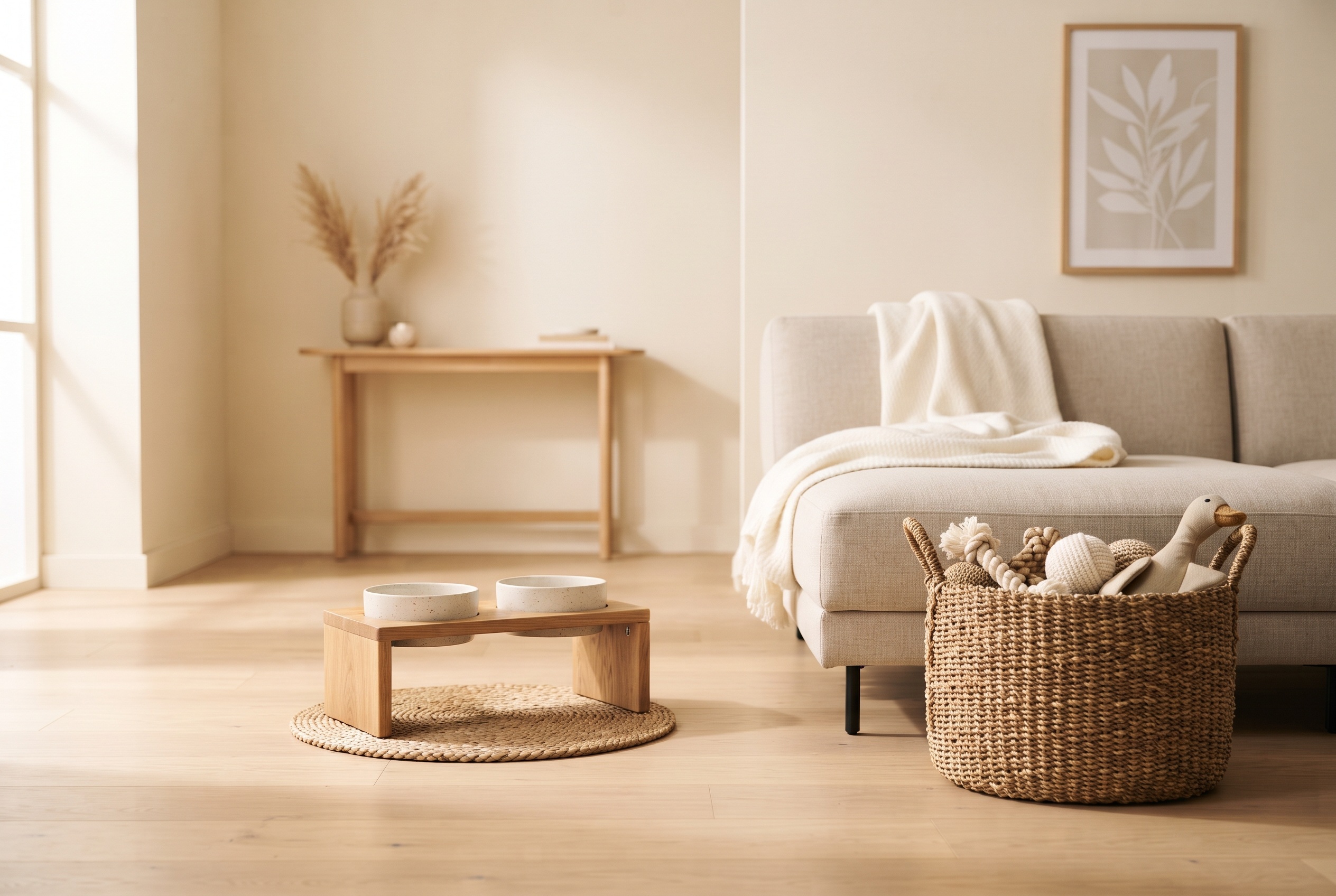
    3. An elevated bowl stand

    An oak elevated feeding stand holding two stainless steel bowls against a cream wall

    Raised feeders are usually sold on health grounds. Treat those claims carefully — the evidence for raised bowls preventing bloat is genuinely contested, and for some deep-chested breeds it may even be a risk factor. Talk to a vet if that’s your reason.

    Where a stand does earn its place is visually and practically: two bowls sunk into a wooden frame stop skidding across the floor, don’t tip, and read as a small piece of furniture rather than two dishes on the tiles.

    Check the bowls lift out and are dishwasher safe. Some frames come with bowls that don’t.

    What I’d buyHTB Elevated Dog Bowl Stand with Steel Bowls★★★★★★★★★★4.54,800 reviews~$36

    4. An airtight food container

    The bag of kibble with the top rolled over and a clip on it is doing more damage to your kitchen than you think, and it’s also letting the food go stale.

    A sealed container fixes both. Look for one with a proper gasket seal — not just a snap lid — and check the capacity against your usual bag size, because they photograph larger than they are.

    Wheels are worth having if you buy the big bags. A full 30 lb container is heavier than it looks.

    What I’d buyIRIS USA Airtight Dog Food Container, 30 lb★★★★★★★★★★4.585,000 reviews~$24

    5. A furniture cover you’d actually leave out

    Most sofa covers are the visual equivalent of putting a bin bag over a chair.

    The ones worth buying are the fitted quilted kind that look like a throw. They’re washable, they stay put, and — this is the part that matters — you don’t have to whip them off when someone comes round, because they don’t look like a defensive measure.

    Buy for your sofa’s measured dimensions, not the label. “Three-seater” varies enormously between manufacturers, and a loose cover looks worse than the hair it’s hiding.

    What I’d buygogobunny Waterproof Furniture Cover★★★★★★★★★★4.418,000 reviews~$23

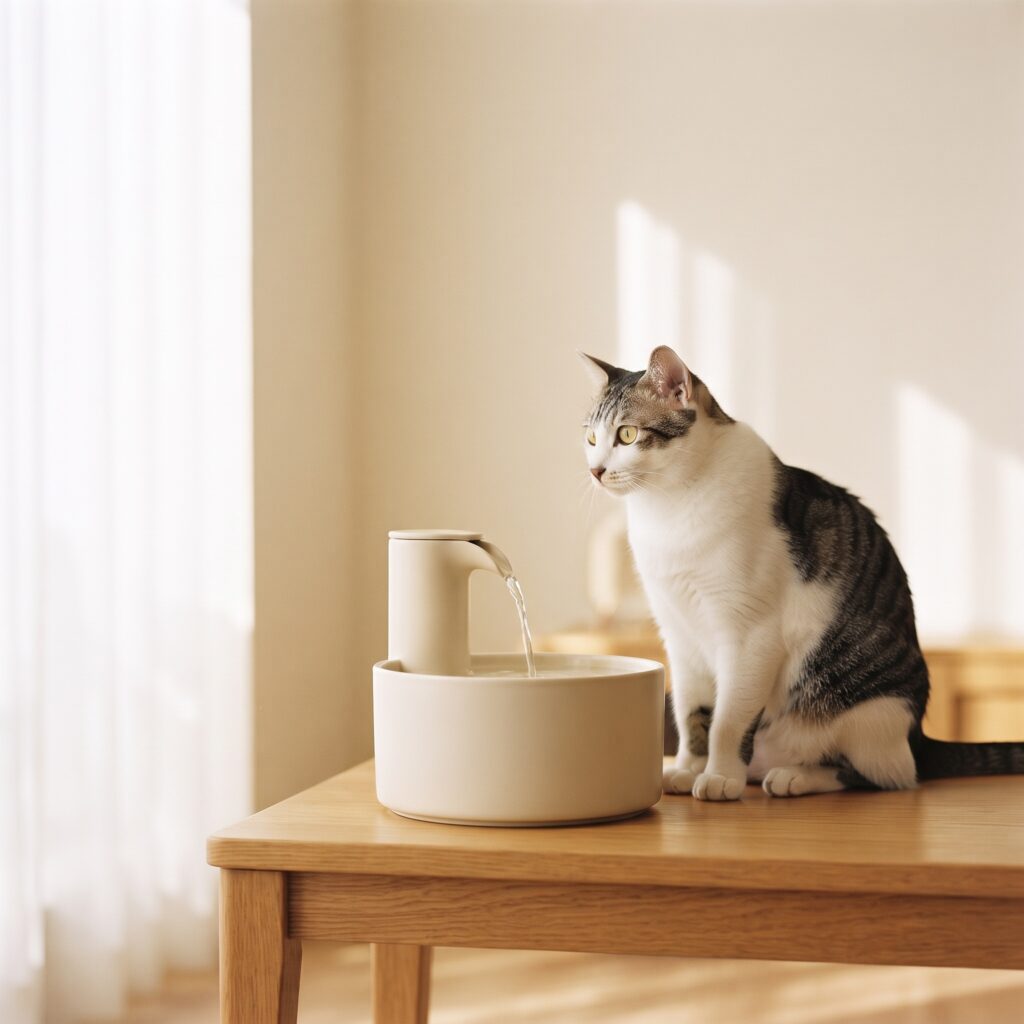
    6. A ceramic water fountain

    A matte cream ceramic pet water fountain on an oak table with a tabby and white cat sitting beside it

    Cats drink more from moving water, which is a real thing and worth knowing if yours is a poor drinker. But the standard fountain is a lump of white plastic with a blue LED, and it hums.

    The ceramic versions cost a little more, are considerably quieter, and don’t stain or hold odour the way plastic does over time. From across a room it reads as a bowl.

    Whichever you buy, commit to cleaning the pump monthly. A neglected fountain is worse than a plain bowl.

    What I’d buyLawfery Ceramic Cat Water Fountain, 2.1L★★★★★★★★★★4.3947 reviews~$39

    Three things I’d skip

    Anything with a paw print on it. The paw print is what turns an object into pet equipment. It’s on almost everything in the pet aisle, and it’s the single easiest thing to avoid.

    Matching “collections.” Several brands sell a coordinated bowl, bed, basket and mat set. They look considered in the product shot, but a room with a matching pet set in it reads as a pet room. Mixing means the individual pieces disappear.

    Designer beds above about $150. There’s a tier of pet furniture priced like real furniture. Some of it is lovely. But dogs and cats have strong opinions about where they sleep that don’t correlate with price, and a $200 bed that gets ignored in favour of the sofa is an expensive ornament. Start cheap, see where they actually sleep, then upgrade that spot.

    Frequently asked questions

    Is the nicer version always more expensive? Usually a little, sometimes not at all. Baskets and bowl stands are often the same price or cheaper than the branded plastic equivalent, because you’re buying from homeware rather than the pet category. Fountains and covers do cost more.

    My cat only likes the ugly plastic thing. Now what? Then keep the ugly plastic thing. Everything here is about the objects your pet is indifferent to — storage, feeding stations, covers. Where they have a genuine preference, the preference wins. That’s not a compromise, it’s the whole point.

    What if I rent and can’t drill? Only the leash holder needs fixings, and heavy-duty adhesive strips handle a leash and harness if you mount it lower than usual. The rest is freestanding.


    None of this is about hiding the fact that you have animals. It’s about the difference between a home where a cat lives and a home that has been surrendered to cat equipment — which, when the equipment costs the same either way, is a choice worth making deliberately.


    Disclosure: As an Amazon Associate, I earn from qualifying purchases. Prices shown are approximate and change frequently; check the current price on Amazon.

  • 7 Indoor Boredom Busters for High-Energy Dogs

    7 Indoor Boredom Busters for High-Energy Dogs

    Disclosure: As an Amazon Associate, I earn from qualifying purchases.

    There’s a moment familiar to anyone with an energetic dog: you’ve just come back from a long walk, you’re tired, and the dog is standing by the door looking at you like nothing happened.

    The instinct is to walk further. It rarely works, and with some dogs it makes things worse — you build fitness, they need more, and you end up in an arms race you can’t win.

    What works better is changing the kind of work rather than the amount.

    Why mental work tires a dog faster

    A dog’s nose is doing serious processing. Scent work engages a huge amount of neural real estate, and the effort involved is real — dogs doing sustained sniffing work show physical signs of exertion without moving much at all.

    The practical upshot, which most owners find hard to believe until they try it: fifteen minutes of concentrated sniffing or problem-solving will settle a dog more reliably than an extra half hour of walking. Not because it’s harder physically, but because it satisfies something the walk didn’t.

    Two mechanisms are worth understanding, because they tell you which tool to reach for:

    Sniffing calms. Searching for food engages what behaviourists call the seeking system — the same drive that makes a dog investigate a hedge for ten minutes. It’s absorbing, it’s self-directed, and dogs come out of it calmer than they went in.

    Licking calms differently. Sustained licking is a self-soothing behaviour. It’s repetitive, rhythmic, and it tends to drop a dog’s arousal level rather than raise it. That makes it the right tool for a specific job: not “tire the dog out” but “bring the dog down” — before guests arrive, during fireworks, when you need to work.

    Those are different problems, and the difference matters when you’re choosing what to buy.

    The rule nobody mentions

    An overhead view of a sage green silicone lick mat spread with peanut butter on an oak floor

    Almost everything below uses food. If you add all of it on top of your dog’s normal meals, you will have a fat dog by spring.

    Take the food out of their daily ration, not in addition to it. A stuffed lick mat can easily be a third of a small dog’s breakfast. If you’ve just brought a dog home, the first-month checklist covers when to introduce each of these. The easiest system is to weigh out the day’s food in the morning and feed it entirely through enrichment — no bowl at all. Dogs work for food willingly, and it turns an unavoidable daily task into the enrichment itself.

    What to use

    A sage and oatmeal snuffle mat on a wool rug with a golden retriever lying beside it

    1. A lick mat — for bringing a dog down

    A textured silicone mat you spread something soft across — wet food, plain yoghurt, mashed banana, pumpkin. The texture means the dog has to work at it, which stretches a few spoonfuls into ten or fifteen minutes of steady licking.

    Best for: settling before guests arrive, during a thunderstorm, or when you need forty minutes of quiet.

    Get one with a suction base if your dog is the type to pick things up and carry them off. And freeze it — a frozen mat takes three to four times longer than an unfrozen one, which is the difference between five minutes and twenty.

    What I’d buyLUKITO Lick Mat with Suction Base, 2 Pack★★★★★★★★★★4.48,700 reviews~$9

    2. A snuffle mat — the highest-value item here

    A mat of dense fabric strips that you scatter dry food into. The dog has to nose through the fabric to find it. It looks almost too simple to work, and it’s the most reliably effective thing on this list.

    Best for: daily use. This is the one to buy first.

    Start easy — food on top, visible — for the first few goes. If the first experience is too hard, some dogs decide the mat isn’t worth investigating and won’t come back to it. Once they’ve got it, bury the food deeper.

    Buy a washable one and wash it. Dry food leaves oils in the fabric and an unwashed snuffle mat goes rancid faster than you’d think.

    What I’d buyPET ARENA Adjustable Snuffle Mat★★★★★★★★★★4.38,000 reviews~$11

    3. A slow feeder bowl — the zero-effort upgrade

    A bowl with a moulded maze in the base. Your dog eats the same food, just around ridges instead of straight up.

    Best for: fast eaters, and anyone who wants an improvement that costs nothing to maintain.

    It won’t tire a dog out — it’s not enrichment in the way the snuffle mat is. What it does is stretch a thirty-second meal into five or ten minutes, which reduces gulping and the bloating that follows.

    Match the maze complexity to the nose. Flat-faced breeds struggle with deep narrow channels; look for shallow, wide patterns for pugs, bulldogs and similar.

    What I’d buyOutward Hound Fun Feeder Slo Bowl★★★★★★★★★★4.6136,000 reviews~$9

    4. A treat-dispensing rubber toy — the classic

    The rubber toy you stuff and the dog works food out of. It’s been around forever because it works and it’s close to indestructible.

    Best for: crate time, being left alone, and anything where the dog needs a job that lasts.

    The trick is stuffing it properly. Loose kibble falls out in ninety seconds. Pack it, add something sticky to hold it together, and freeze it — a well-packed frozen one can occupy a determined dog for half an hour or more.

    Size up rather than down, and check it regularly for damage. A chewed-through rubber toy stops being a toy and becomes a hazard.

    What I’d buyKONG Classic Dog Toy★★★★★★★★★★4.693,000 reviews~$12

    5. An interactive puzzle toy — for the dogs that need more

    Sliding covers, flip lids, rotating discs. Real problem-solving rather than nose work.

    Best for: clever dogs who solve the snuffle mat in four minutes and look at you expectantly.

    Start at level one, even if you think your dog is smart. The failure mode here is a dog who can’t work it out, gets frustrated, and stops engaging — and that’s much harder to undo than starting too easy.

    Supervise the first few sessions. A puzzle a dog can’t solve is a puzzle some dogs will simply chew through.

    What I’d buyNina Ottosson Dog Smart Puzzle (Level 1)★★★★★★★★★★4.417,000 reviews~$13

    6. A treat pouch — for the free option

    The most underrated item, because it isn’t really about the pouch. It’s about making five-minute training games frictionless.

    Ten minutes of teaching a new trick is genuinely tiring for a dog — focus, impulse control, repeated decisions. But it only happens if the treats are already to hand. A pouch on a hook by the door means the barrier drops from “go find the treats, wash hands, start” to nothing.

    Get one with a hinged opening that snaps shut rather than a drawstring. You’ll be reaching in one-handed while the other hand is doing something else.

    What I’d buyheouvo Magnetic Dog Treat Pouch★★★★★★★★★★4.54,100 reviews~$10

    7. The one that costs nothing: scatter feeding

    Take your dog’s dry food. Throw it across the lawn, or across a rug indoors. Walk away.

    That’s it. Ten to twenty minutes of nose-down searching, no equipment, no cost. It works on the same principle as the snuffle mat and it’s how I’d suggest testing whether scent work does anything for your dog before spending money on it.

    Indoors, use a low-pile rug or a towel spread out — smooth floors mean the food skitters and the searching part disappears.

    Three things I’d skip

    An overhead view of a cream slow feeder bowl filled with kibble in its winding channels

    Automatic ball launchers. They look like the perfect solution — endless fetch without your arm. The problem is that repetitive high-speed chasing raises arousal rather than lowering it, and some dogs develop a genuinely obsessive relationship with the ball. You end up with a dog who is fitter, more wound up, and harder to switch off.

    TV channels made for dogs. Passive watching isn’t enrichment. Some dogs are mildly interested for a few minutes; most ignore it entirely. It doesn’t engage the nose, the brain, or the body.

    Puzzle toys above level 2, bought first. Advanced puzzles are the most common enrichment purchase that ends up in a cupboard. Dogs need to learn how to engage with puzzles at all before difficulty means anything.

    Frequently asked questions

    How long should an enrichment session be? Shorter than you’d think. Ten to fifteen minutes of concentrated nose work is a real session. Two short sessions beat one long one, and stopping while the dog is still keen is what makes them enthusiastic next time.

    My dog finishes everything in two minutes. What now? Freeze it, pack it tighter, or make it harder to reach — put the snuffle mat inside a box, or the stuffed toy under a blanket. Difficulty is usually a presentation problem, not a product problem.

    Can this replace walks? No. Walks provide exercise, novelty and outdoor scent that indoor work can’t match. This is for the gap between what a walk delivers and what your dog still needs — which for a young working breed can be substantial. On days when a proper walk isn’t possible, it’s a reasonable stand-in for one day, not a replacement.


    The measure of whether this is working isn’t whether your dog enjoys it — most dogs enjoy anything involving food. It’s what happens twenty minutes afterwards. A dog who settles on their own, without being told, has had the thing they were actually asking for.


    Disclosure: As an Amazon Associate, I earn from qualifying purchases. Prices shown are approximate and change frequently; check the current price on Amazon.

  • 9 Small Space Cat Ideas That Don’t Ruin Your Living Room

    9 Small Space Cat Ideas That Don’t Ruin Your Living Room

    Disclosure: As an Amazon Associate, I earn from qualifying purchases.

    The standard advice for keeping a cat in a small flat is to buy less stuff. It’s not wrong exactly, but it’s solving the wrong problem — because the thing your cat is short of usually isn’t stuff. It’s territory.

    And here’s the useful part: territory, for a cat, is measured in volume, not floor area. You can’t make your living room wider. You can absolutely make it taller.

    That single shift is why a 40 m² flat can be a perfectly good home for a cat, and why some much larger flats aren’t. Below is how to do it, plus the six things that actually earn their footprint.

    Why vertical space works

    Cats evolved to use height. A raised position gives a wide field of view, an escape route, and distance from anything unpredictable at ground level — which in a flat means the door, the hoover, and visitors’ feet.

    Three things follow from that, and they’re worth knowing before you buy anything:

    Height reduces stress. A cat with somewhere high to retreat to has an option other than hiding under the bed. In practice this shows up as a cat who stays in the room when guests arrive instead of vanishing for the evening.

    Height reduces conflict between cats. Two cats in a small flat with only floor space are permanently in each other’s territory. Add vertical levels and they can share a room while occupying different zones. This is one of the most reliable fixes for low-level tension between housemate cats.

    Height is free. The wall above waist height in most flats is doing nothing. It’s the only square footage you can add without moving.

    The other principle worth holding onto: sightlines matter as much as height. A shelf facing a blank wall gets ignored. A perch with a view of the room, or of the window, gets used constantly. Before mounting anything, sit on the floor where it’ll go and ask what the cat would be looking at.

    What actually earns its space

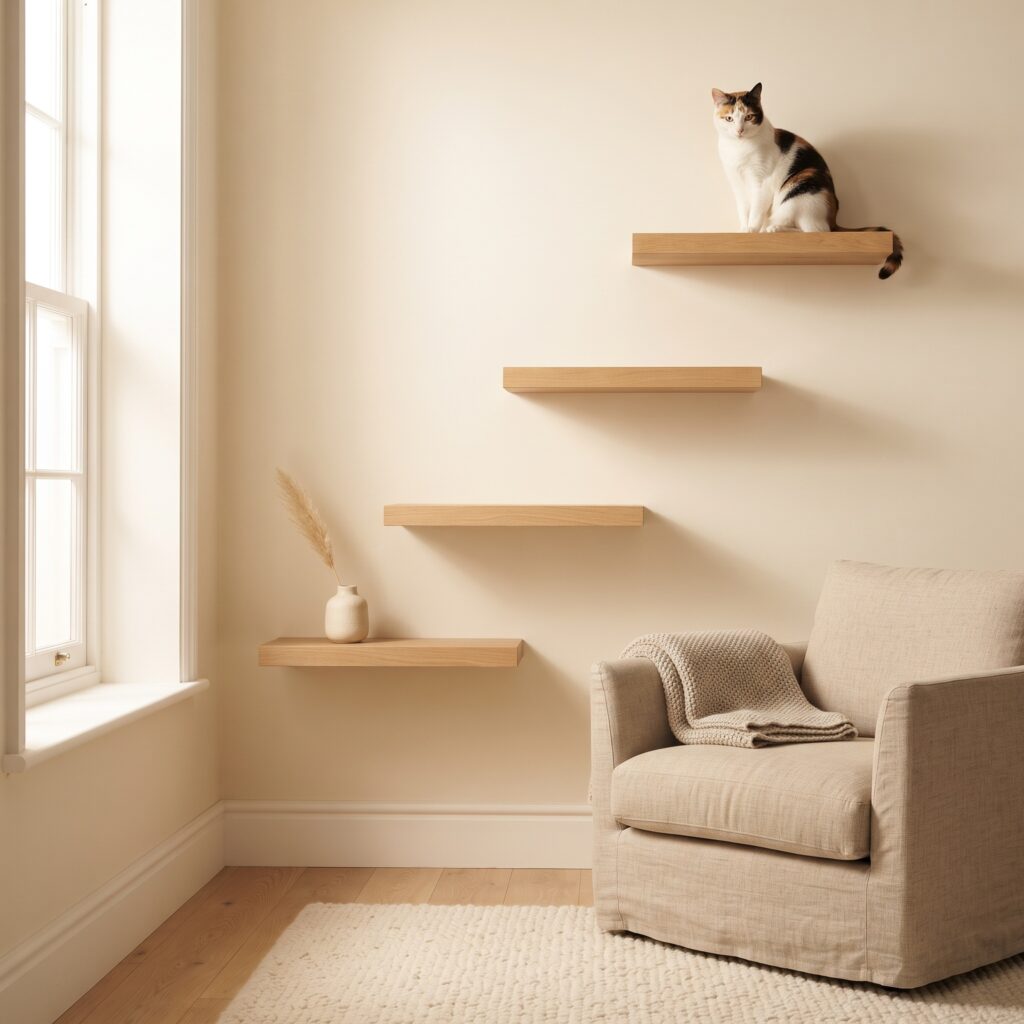
    Floating oak wall shelves arranged as a staircase with a grey cat on the highest shelf

    1. A window perch — the highest-value square foot in the flat

    If you buy one thing on this list, buy this.

    A suction-mounted hammock puts your cat at the window with zero floor footprint. Window watching is the single most reliable form of enrichment for an indoor cat — movement, birds, weather, people — and it costs you nothing but wall.

    The suction cups are the whole product, so don’t buy the cheapest. Look for four large cups rather than three small ones, and clean both the cups and the glass before mounting; grease is what makes them fail. Mount it low the first week so a fall isn’t a fall, then raise it once you’ve seen it hold.

    What I’d buyAMOSIJOY Cordless Cat Window Perch★★★★★★★★★★4.514,000 reviews~$19

    2. Wall shelves — the actual solution

    A set of wall-mounted shelves and steps turns an empty wall into a route. Done properly, your cat can get from floor to the top of a bookcase without touching the ground.

    The design rule that matters: shelves need to form a path, not a display. Spacing of roughly 30–40 cm vertically and staggered horizontally, so each step is an easy hop. Too far apart and they won’t use it; perfectly in a vertical line and they can’t.

    Give it a destination — the top step should lead somewhere good, like a perch by the window or the top of a cupboard. A route to nowhere doesn’t get walked.

    Fix into studs or use proper wall anchors. A shelf that shifts once will never be trusted again.

    What I’d buyFUKUMARU 70″ Cat Wall Shelves Set★★★★★★★★★★4.41,700 reviews~$50

    3. Hidden litter box furniture — the biggest visual win

    In a small flat there’s nowhere to put a litter box where it isn’t in a room you use. So the move is to stop trying to hide it and start disguising it.

    A cabinet or side table with an entrance cut into the side does exactly that. From the outside it’s furniture. Inside it’s a litter box, with the tray contained so scatter stays in the cabinet rather than on your floor.

    Two things to check: that the top actually lifts off or opens fully — some models only have the cat door, which makes cleaning miserable — and that the internal dimensions fit your actual tray, not a generic one.

    This is the most expensive item on the list, and it’s the one that most changes how a small living room feels.

    What I’d buyHzuaneri Cat Litter Box Enclosure Cabinet★★★★★★★★★★4.6967 reviews~$85

    4. A litter trapping mat

    Small flat, so the litter box is near where you live, so the litter it scatters is also near where you live.

    A textured trapping mat catches what comes out on your cat’s paws and holds it until you shake it out. The double-layer kind — where granules fall through the top surface into a pocket underneath — works considerably better than a single flat mat.

    Get one wider than you think. Cats leave the tray in whatever direction they feel like.

    What I’d buyPieviev Double-Layer Cat Litter Mat★★★★★★★★★★4.474,000 reviews~$14

    5. A wall-mounted scratcher

    A floor scratching post costs you floor. A sisal board that mounts to the wall or a door doesn’t.

    The height is the point: cats stretch fully when scratching vertically, and a wall-mounted board lets them do that without a base sitting in your room. It also protects the specific bit of wall or door frame they’ve already decided is theirs.

    Mount it where they already scratch, not where you’d prefer they scratched. You’re redirecting a habit, not creating one.

    What I’d buy34″ Wall-Mounted Sisal Cat Scratcher★★★★★★★★★★4.6598 reviews~$27

    Three more ideas that cost nothing

    A tabby cat curled asleep in a fabric hammock mounted to a sunny window

    Clear the top of one bookcase. You have a perch already; it’s just currently covered in books and a plant. Cats overwhelmingly prefer the highest accessible surface in a room. Clearing one is free.

    Move the litter box away from the food. Cats won’t eat next to a toilet, and in a small flat these end up close together by default. Even a couple of metres and a corner between them makes a measurable difference to how much cats use both.

    Use the space under the bed properly. Not for the cat — for the cat’s supplies. Litter, food, spare toys, the carrier. Under-bed storage is the most underused volume in a small flat, and getting bulky supplies out of your cupboards buys you back the space you actually notice.

    Five things I’d skip

    A wooden side table cabinet with a small round cat entrance cut into one side

    Tall cat trees, floor-standing or floor-to-ceiling. I went looking for one to recommend here and kept running into the same thing: Amazon flags a striking number of them as frequently returned items. The pattern is consistent enough to take seriously, and the reasons are predictable — wobble after assembly, tension poles that slip, and shipping damage, all of which get worse the taller the thing is. Shelves fixed properly into a wall give you the same vertical territory with none of that, which is why they are the recommendation above.

    Door-mounted cat towers. The appeal is obvious — vertical territory with no drilling — and for that reason I looked hard at the category before ruling it out. Every model I could find except one sits between 2.2 and 3.9 stars, most on fewer than fifty reviews. The single respectable option is flagged by Amazon as a frequently returned item, and its reviews say the same thing over and over: the cat won’t use it. Whether the cat takes to it is the most-discussed aspect of that product by a wide margin — ahead of price, ahead of assembly, ahead of everything.

    That isn’t a manufacturing fault, it’s the design. The thing hangs on a door, and a door moves. Even five-star owners describe it as shaky. Cats test a surface before committing weight to it at height, and a platform that gives underfoot fails that test — which is also why straps loosening over time matters more here than it would on a floor-standing tree. Wall shelves work precisely because they don’t move. If drilling is genuinely out of the question, the window perch asks nothing of your cat’s confidence and costs a third as much.

    Cat tunnels and floor-level play furniture. Fun, and cats do use them — but they consume floor space, which is exactly the resource you’re short of. In a bigger flat, sure. Not here.

    Enclosed hooded litter boxes as a space solution. They don’t save space; they have the same footprint plus a lid. They also concentrate smell inside, which means you notice it less and your cat notices it more. If the goal is hiding the box, use furniture. If the goal is smell, clean it more often.

    Multi-tier cat trees under about 120 cm. They occupy the footprint of a real cat tree while delivering height your cat could reach by jumping on the sofa. Either go properly tall or go wall-mounted; the middle is the worst of both.

    Frequently asked questions

    How many litter boxes do I need in a small flat? The standard guidance is one per cat plus one — so two boxes for one cat. In a genuinely small flat that’s often impractical, and one immaculately maintained box is better than two neglected ones. If you have two cats, though, find room for two. Resource competition around a single box is a common cause of going outside it.

    Will wall shelves damage my rental? They need fixings, so yes, there will be holes. Filling and repainting a few anchor holes is normally accepted end-of-tenancy work, but check your agreement. If drilling is genuinely out, the window perch and a corner tree get you most of the vertical benefit with no fixings at all.

    My cat ignores everything I buy. What am I doing wrong? Usually placement, not product. Cats use things that are on a route they already walk, near a view they already like, or in a spot they already sit. Watch where your cat actually goes for a few days, then put the thing there. A perch in the wrong corner will sit unused for years.


    None of this makes a small flat bigger. What it does is stop the flat and the cat competing for the same square metres — and once you’ve built upwards, the room you get back is yours.


    Disclosure: As an Amazon Associate, I earn from qualifying purchases. Prices shown are approximate and change frequently; check the current price on Amazon.
  • Build a Dog Station in Your Entryway (Under $100)

    Build a Dog Station in Your Entryway (Under $100)

    Disclosure: As an Amazon Associate, I earn from qualifying purchases.

    Look at the space just inside your front door. If you have a dog, I can probably guess what’s there: a leash draped over a radiator or dumped on the floor, a half-empty bag of treats, poo bags in a coat pocket somewhere, a towel that’s been on the same hook since the last rainy walk, and a rug that’s a slightly different colour than it used to be.

    None of that is a storage problem exactly. It’s a sequencing problem — the things you need for a walk and the things you need after a walk are scattered across three rooms, so they end up living wherever you last put them down.

    A dog station fixes it by putting the whole sequence in one place. Here’s how I’d build one, what goes in it, and what it costs.

    The logic: build around the sequence, not the stuff

    Most “dog station” posts are just a list of storage bins. That misses the point. What makes the difference is arranging it in the order you actually use it.

    Going out: leash → poo bags → treats

    Coming in: paws → towel → leash back on hook

    If you set it up in that order — left to right, or top to bottom — you stop thinking about it. Everything is where your hand already is. If you don’t, you’ve just moved the mess into a nicer basket.

    Three practical constraints worth knowing before you buy anything:

    Height matters more than you’d expect. Hooks want to be at about shoulder height for you and out of reach for the dog. Too low and a bored dog will help themselves to a leash. Too high and you won’t use it when your hands are full.

    Leave the floor clear. Wall-mounted beats floor-standing in an entryway, always. Floor space in a hallway is the most contested space in a house, and anything sitting on it becomes something to step around.

    The dirty zone and the clean zone need separating. Paw-cleaning and towels live at the bottom. Food and treats live at the top. This sounds fussy until the first time you knock a wet towel into an open treat container.

    What goes in it

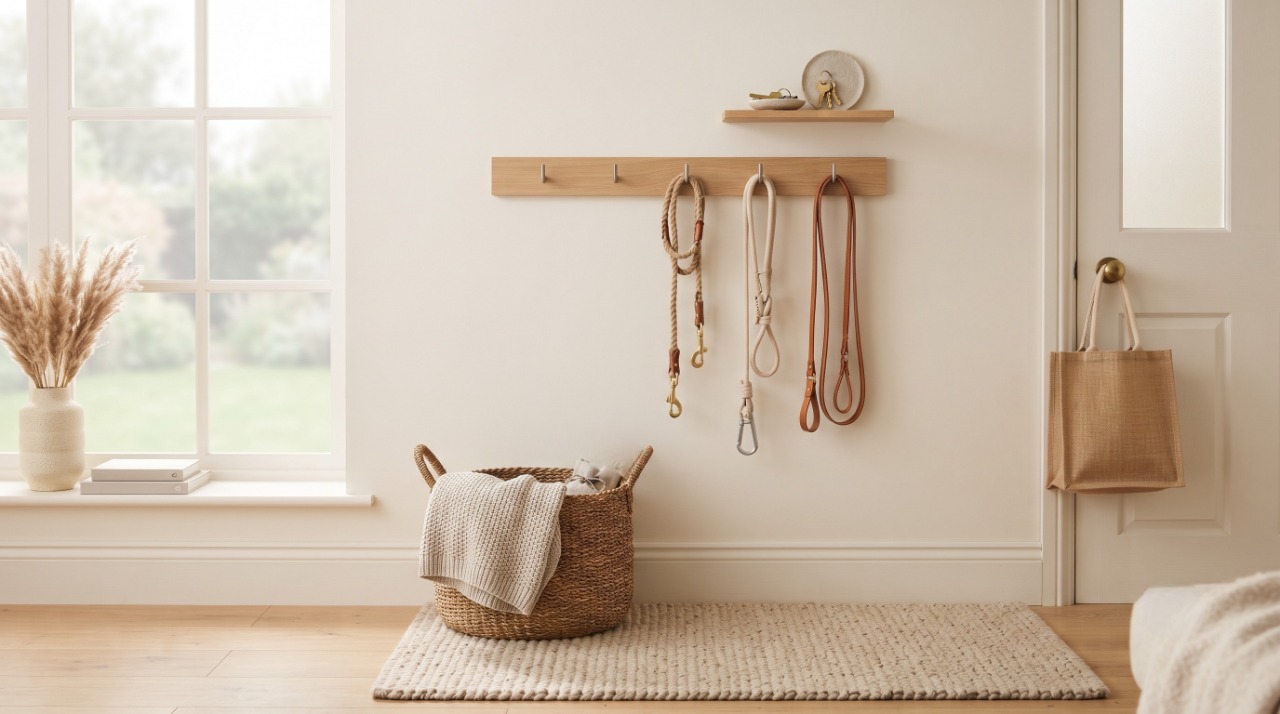
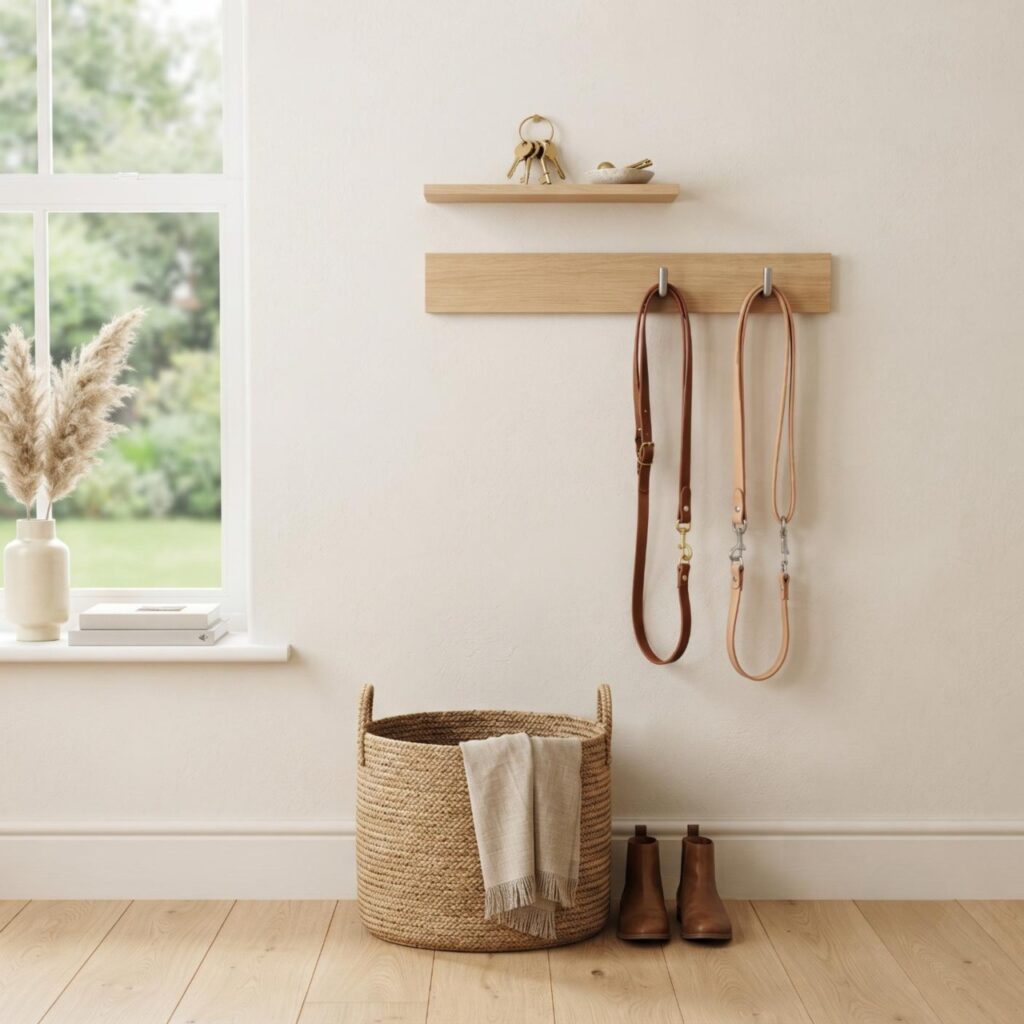
    An oak wall rail with two leather leashes hanging and a small shelf above

    1. A wall-mounted leash holder

    The anchor of the whole thing. A rail with three or four hooks holds leashes, harnesses, a spare lead, and a tote bag, all off the floor and all visible.

    Look for one with a small shelf or tray on top if you can — that’s where keys, poo bag rolls, and a torch end up living, which keeps them out of your coat pockets.

    Mount it at your shoulder height, not eye height. You’ll be reaching for it while holding a dog.

    What I’d buyWall-Mounted Key Holder with 6 Hooks & Shelf★★★★★★★★★★4.7475 reviews~$27

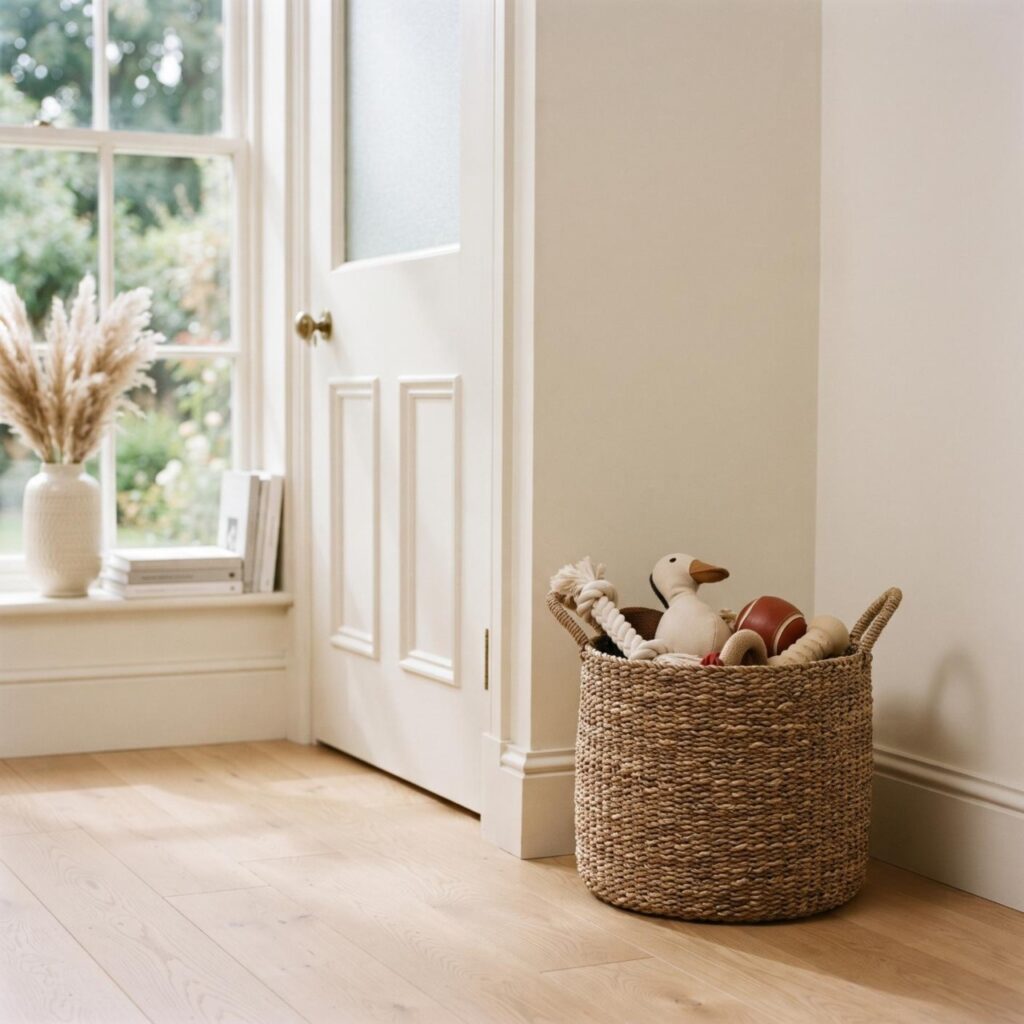
    2. A basket for toys

    Toys migrate. They start in the living room, end up under the sofa, and you find them with your foot at midnight. A basket by the door gives them one destination — and if you make a habit of dropping them in on the way past, the rest of the house stays clearer.

    Seagrass or woven baskets look like furniture rather than pet storage, which matters if your entryway is visible from your living room. Get one deeper than you think you need; toys expand to fill available space.

    What I’d buyDeco 79 Seagrass Storage Basket, Large★★★★★★★★★★4.61,600 reviews~$38

    3. An airtight food container

    If your dog’s food is currently in the original bag with the top rolled over, this is the highest-impact swap on the list — and not just for tidiness.

    Kibble goes stale once air gets to it, and the fats in it oxidise, which is why food from the bottom of an old bag smells different and fussy dogs start refusing it. An airtight seal keeps it edible to the last scoop. It also keeps out pantry moths, which are a nightmare to get rid of once established.

    Measure the container against your usual bag size before buying. A 30 lb bag needs a bigger container than the photos suggest.

    What I’d buyIRIS USA Airtight Dog Food Container, 30 lb★★★★★★★★★★4.585,000 reviews~$24

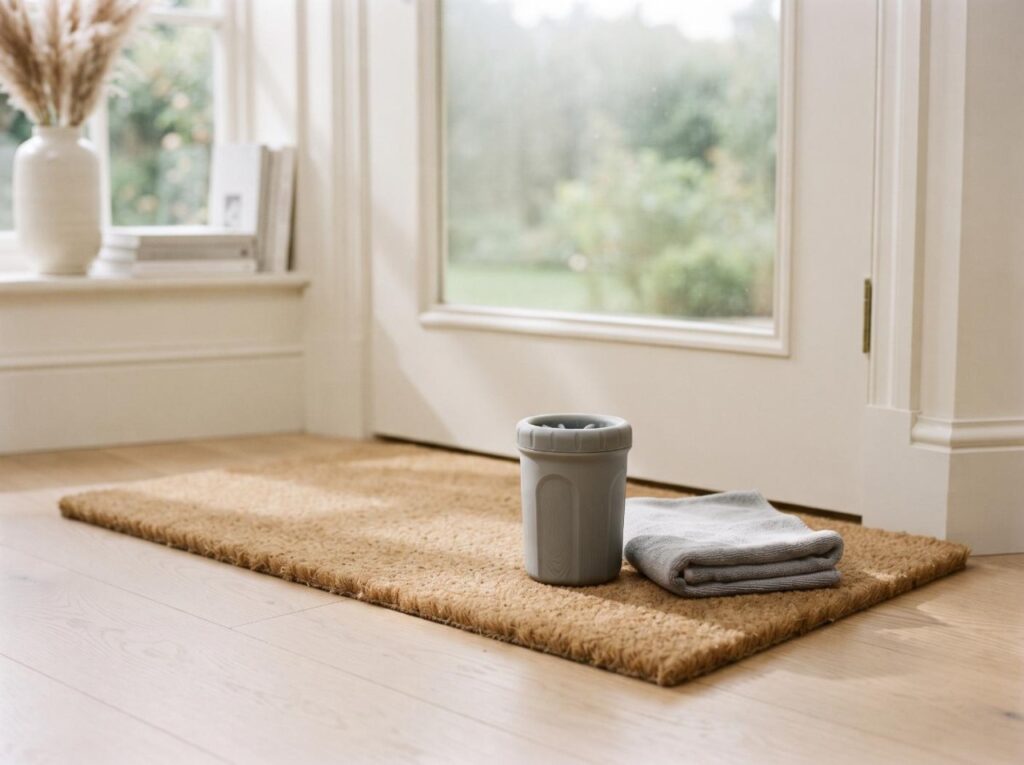
    4. A paw cleaner cup

    The single item that changes your floors the most.

    It’s a cup with soft silicone bristles inside. Add a little water, dip each paw, twist, wipe with the towel. Takes about twenty seconds for all four and removes the mud that would otherwise end up on your hallway, then your rug, then your sofa.

    Get the size right — too small and the paw won’t fit, too big and you’re wasting water and the bristles won’t reach. Check the sizing chart against your dog’s paw, not their body weight.

    What I’d buyDexas MudBuster Paw Cleaner, Medium★★★★★★★★★★4.425,000 reviews~$10

    5. A microfibre drying towel

    A dedicated dog towel that lives on a hook by the door, not the bathroom towel you keep meaning to replace. It works alongside the paw cup — and if hair rather than mud is your problem, this is what actually removes it.

    Microfibre matters here: it holds several times its weight in water and dries fast enough that it doesn’t go sour hanging on a hook between walks. A normal cotton towel in an unventilated hallway starts to smell within about two days.

    Buy two. One on the hook, one in the wash.

    What I’d buyBone Dry Microfiber Pet Grooming Towel★★★★★★★★★★4.511,000 reviews~$14

    6. A washable absorbent door mat

    The last line of defence. A dedicated mat in front of the door catches whatever survives the paw cup, and — the important part — goes in the washing machine.

    Look for one that’s specifically machine washable and has a rubber backing so it doesn’t slide when a dog comes through the door at speed. Non-slip matters more than it sounds; a mat that shifts underfoot is how you end up on the floor holding a lead.

    What I’d buySmiry Absorbent Non-Slip Dog Door Mat★★★★★★★★★★4.66,500 reviews~$9

    What it costs

    A woven seagrass basket filled with dog toys beside a white panelled front door

    Item Typical price
    Leash holder with shelf $18–30
    Woven basket $25–40
    Airtight food container $25–40
    Paw cleaner cup $12–18
    Microfibre towel $12–20
    Washable door mat $20–35

    Buying all six puts you at the top of that range. If you’re building this gradually, do it in this order: leash holder, then paw cup, then towel, then mat, then basket, then food container. The first three change your daily routine; the last three are quality-of-life.

    Three things I’d skip

    A silicone paw cleaner cup and a folded microfibre towel resting on a doormat

    Branded “dog station” kits. Several companies sell the whole set as one unit for $80–120. They look coordinated in the product photo, but you’re paying a premium for matched wood grain, and the individual pieces are usually worse than what you’d choose separately. Buy the parts.

    Anything with the dog’s name carved into it. Personal preference, and yours may differ — but a personalised sign is the thing most likely to make an entryway read as “pet zone” rather than “entryway that happens to include a dog.” The whole point of building this well is that a visitor shouldn’t clock it.

    Over-door hook racks, for leashes specifically. They’re fine for coats. But an over-door rack swings every time the door moves, and a leash hanging on a swinging hook will eventually catch and drop. Use the wall.

    Frequently asked questions

    What if my entryway is tiny? Then wall-mounting isn’t optional, it’s the whole strategy. A leash rail with a shelf plus a paw cup on the floor beneath it is a complete station in about 40 cm of wall. Skip the basket and keep toys elsewhere.

    Can I do this in a rental without drilling? Partly. Heavy-duty adhesive strips will hold a leash rail if you’re honest about the weight — a leash and a harness, not a bag of dog food. Everything else on this list is floor-standing or hanging anyway. Check the weight rating and mount it lower than you would a drilled fixing; less leverage means less chance of it peeling off the wall.

    Where should the food container go — entryway or kitchen? Kitchen, if you have the room. It’s the only item here that isn’t part of the walk sequence, and it’s the heaviest thing to move. It’s on this list because a lot of people don’t have kitchen space for it, not because the entryway is ideal.


    The test of whether this works isn’t how it looks the day you finish it. It’s whether, three weeks later, the leash is still on the hook. If the sequence is right, it will be — because putting it back is genuinely easier than not.


    Disclosure: As an Amazon Associate, I earn from qualifying purchases. Prices shown are approximate and change frequently; check the current price on Amazon.
  • How to Get Dog Hair Off Everything: 5 Things That Actually Work

    How to Get Dog Hair Off Everything: 5 Things That Actually Work

    Disclosure: As an Amazon Associate, I earn from qualifying purchases.

    If you live with a shedding dog, you already know the drill. You vacuum on Saturday. By Sunday afternoon the couch looks like it grew a coat. You lint-roll a black shirt for two minutes and still find hair on your shoulder at lunch.

    I spent a while working out which tools genuinely solve this and which ones just move hair around. Below are the five that earned a permanent spot in my house, organised by where the problem actually is — plus four popular things I’d skip.

    First, why dog hair is so hard to remove

    This is worth thirty seconds, because it explains why some tools work and others don’t.

    Pet hair doesn’t just sit on fabric. It has a slightly rough, scaled surface, and it carries a static charge. On upholstery and knits, those scales hook into the weave and the static holds them there. That’s why a sticky lint sheet lifts the loose surface hair and leaves the embedded hair completely untouched.

    Anything that actually works does one of three things:

    1. Uses static against itself — rubber and silicone generate an opposing charge that pulls hair up out of the weave.
    2. Physically rakes it out — a stiff edge drags embedded hair to the surface where it can be collected.
    3. Stops it landing there in the first place — either by removing loose undercoat from the dog, or by putting a washable layer between the dog and your furniture.

    Almost every product below is one of those three. If a product isn’t, be sceptical.

    1. A reusable roller (for clothes and quick jobs)

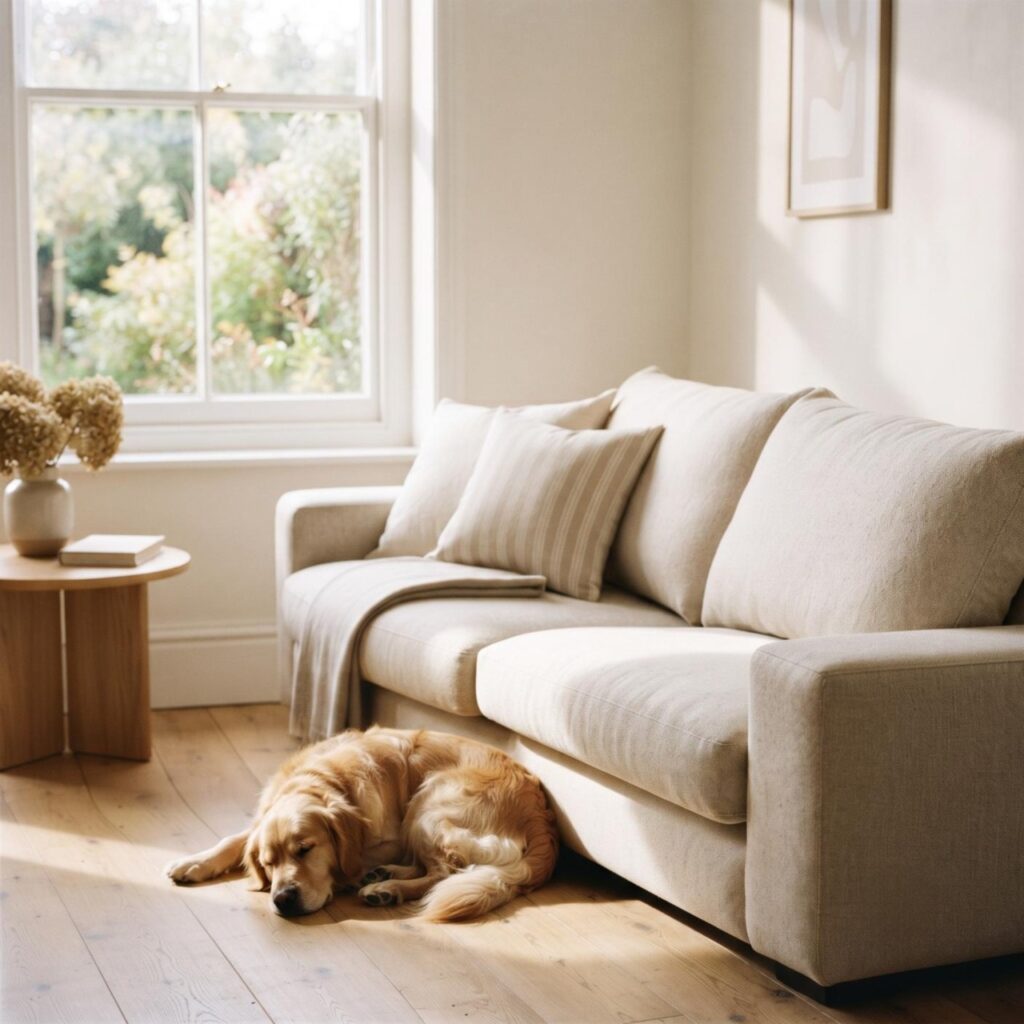
    A golden retriever asleep on the floor beside a cream sofa

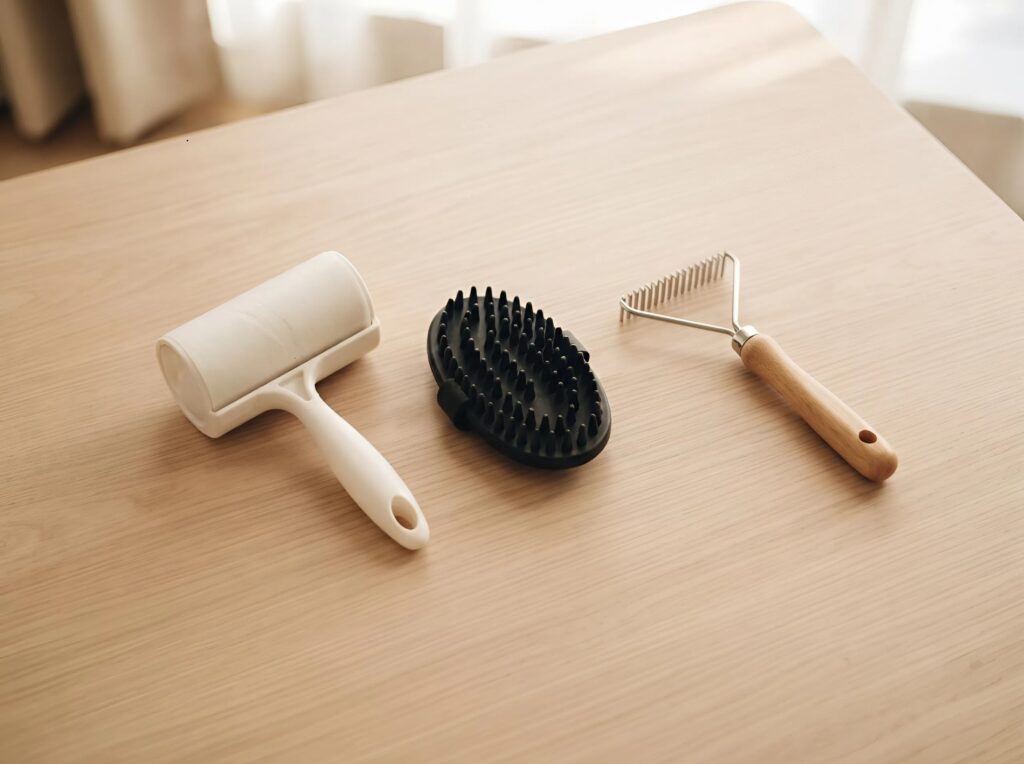
    The first upgrade to make is dropping disposable sticky sheets. A reusable roller uses a textured surface instead of adhesive, so it lifts hair the sheets slide over — and you empty it into the bin instead of buying refills forever.

    Best for: clothes, car seats, bedding, and the thirty seconds before you leave the house.

    Worth knowing: it works in one direction. Roll it back and forth like a paint roller and you’ll undo half your work. One direction, then empty.

    What I’d buyChomChom Roller Pet Hair Remover★★★★★★★★★★4.5206,000 reviews~$25

    2. A rubber-edged hair remover (for the couch and carpet)

    This is the one that surprises people. It’s a simple tool with a stiff rubber or silicone edge, and you drag it across upholstery in short strokes. The hair comes up in visible grey ropes — hair your vacuum had been driving over for months.

    Best for: sofas, armchairs, car upholstery, and rugs.

    Worth knowing: it takes real effort, and on a large sofa it’s a ten-minute job, not a two-minute one. It’s also strangely satisfying, which is probably why it’s the tool in my house that actually gets used.

    What I’d buyLilly Brush Mini Pet Hair Detailer★★★★★★★★★★4.654,000 reviews~$16

    3. A deshedding brush (fix the source)

    Every tool above is cleanup. This one is prevention, and it changes the problem more than the other five combined.

    Most shedding is loose undercoat that hasn’t fallen out yet. Ten minutes of brushing outside removes hair that would otherwise spend the next week landing on your furniture. Do it twice a week during a shedding season and the difference is not subtle.

    Best for: double-coated breeds — Huskies, Golden Retrievers, German Shepherds, Corgis.

    Worth knowing: don’t over-brush the same spot. Deshedding tools reach the undercoat, and repeated passes over one area can irritate the skin. Short sessions, whole dog, then stop.

    What I’d buyMaxpower Planet Deshedding Rake★★★★★★★★★★4.660,000 reviews~$14

    4. A rubber broom (for hard floors and low-pile rugs)

    On hardwood and tile, hair doesn’t stick — it drifts. A normal broom pushes it into the air and it lands somewhere else. A rubber broom gathers it into a clump you can actually pick up, and the same tool works on low-pile rugs where a vacuum tends to skim over.

    Best for: hardwood, tile, laminate, entryway rugs.

    Worth knowing: mist the floor lightly with water first. Damp hair clumps instead of scattering, and the difference is significant.

    What I’d buyMR.SIGA Rubber Broom with Squeegee★★★★★★★★★★4.215,000 reviews~$20

    5. A washable furniture cover (for the sofa you’ve given up on)

    If your dog is on the couch and that isn’t changing, stop fighting the fabric and put a layer over it. A fitted, washable cover means the weekly job becomes a wash cycle instead of an hour of scraping. There are a few more of these — pet things that don’t look like pet things — in this round-up.

    Best for: rented flats, light-coloured sofas, and dogs who have already won the argument about the couch.

    Worth knowing: buy for your sofa’s actual measurements, not its description. “Three-seater” means different things to different manufacturers, and a loose cover slides around and looks worse than the hair did.

    What I’d buygogobunny Waterproof Furniture Cover★★★★★★★★★★4.418,000 reviews~$23

    Four things I’d skip

    A lint roller, rubber grooming brush and metal rake on a wooden table

    Laundry hair-catchers. These are the rubber discs you throw in the washing machine, and they are everywhere in articles like this one. I left them out after looking at the numbers: the category leader has over 61,000 reviews and an average of 3.5 stars, and every alternative I could find was either rated similarly or had almost no reviews at all. Sixty thousand people at three and a half stars is not ambiguous. Wash pet-covered items separately and run an empty rinse cycle afterwards instead — it costs nothing and it works.

    Disposable lint rollers. Fine for a suit jacket on the way out the door. On upholstery they lift the top layer and leave everything embedded, and the refill cost adds up faster than you’d think.

    Rubber gloves as a hair tool. They do work — the technique is real, and a damp rubber glove will pull hair off a cushion. But it’s slow, and a purpose-made rubber tool does the same job in a third of the time. Use it if you already have gloves; don’t buy gloves for this.

    Robot vacuums, as a hair solution specifically. They’re genuinely useful for daily maintenance on hard floors. But long hair wraps around the brush roll, and with a heavy shedder you’ll spend more time cutting hair off the roller than you save. It’s a floor tool, not a hair tool.

    Frequently asked questions

    Does fabric softener actually help with pet hair? Somewhat, and the reason is static. Softener and dryer sheets reduce the static charge that holds hair to fabric, so more of it releases into the lint trap. It’s a useful supporting habit, not a solution on its own.

    Should I vacuum before or after using a rubber hair tool? After. The rubber tool pulls embedded hair up to the surface; vacuuming then picks it up. Do it the other way round and the vacuum drives over the hair that matters.

    How often should I brush a heavy shedder? Twice a week normally, and daily during a seasonal blow-out — typically spring and autumn for double-coated breeds. Short sessions beat long ones.


    Nothing here removes dog hair permanently, and any product promising that is lying to you. But the combination of one prevention tool and two cleanup tools moves this from a constant background irritation to a ten-minute weekly job — which, when you look at the dog, is a trade most of us would take.


    Disclosure: As an Amazon Associate, I earn from qualifying purchases. Prices shown are approximate and change frequently; check the current price on Amazon.