
Disclosure: As an Amazon Associate, I earn from qualifying purchases.
I’ve lived with cats for over twenty-five years — twelve of them, at various points — and the litter box is the one problem that never fully goes away. If space is the constraint rather than smell, the small-space cat guide covers the vertical side of it. It just becomes better or worse managed.
Most advice about it is about smell. Smell is real, but it’s a symptom. The actual problems are three: the box is in a room you use, the litter travels, and the whole arrangement announces itself. Fix those and the smell mostly takes care of itself.
Start with the things that cost nothing
Before buying anything, two changes do more than any product.
Scoop daily, not every other day. This is unglamorous and it is the entire answer to smell. A box scooped every morning does not smell. A box scooped every second day does, and no amount of deodorising litter, charcoal filter, or air freshener changes that — those things mask a problem that takes ninety seconds to remove.
Move the box away from the food. Cats are strongly averse to eating near a toilet, and in a small flat these two things end up close together by default. Even a couple of metres and a corner between them measurably improves how willingly a cat uses both.
The related rule, if you have more than one cat: one box per cat, plus one. Two cats want three boxes. In a small flat that’s often impractical, and one immaculately maintained box beats two neglected ones — but resource competition around a single box is one of the most common causes of a cat going elsewhere.
1. Furniture that hides the box

The single change that most alters how a room feels.
A cabinet or side table with an entrance cut into the side reads as furniture from the outside and contains a litter tray inside. The scatter stays in the cabinet rather than on your floor, and visitors don’t clock what it is.
Two things to check before buying:
The top must open fully, not just the cat door. Some designs only have the entrance, which turns cleaning into an exercise in contortion, and a box that’s annoying to clean is a box that gets cleaned less.
Measure the interior against your actual tray. Listings quote external dimensions. The internal space is often considerably smaller than the photo suggests.
2. A double-layer trapping mat
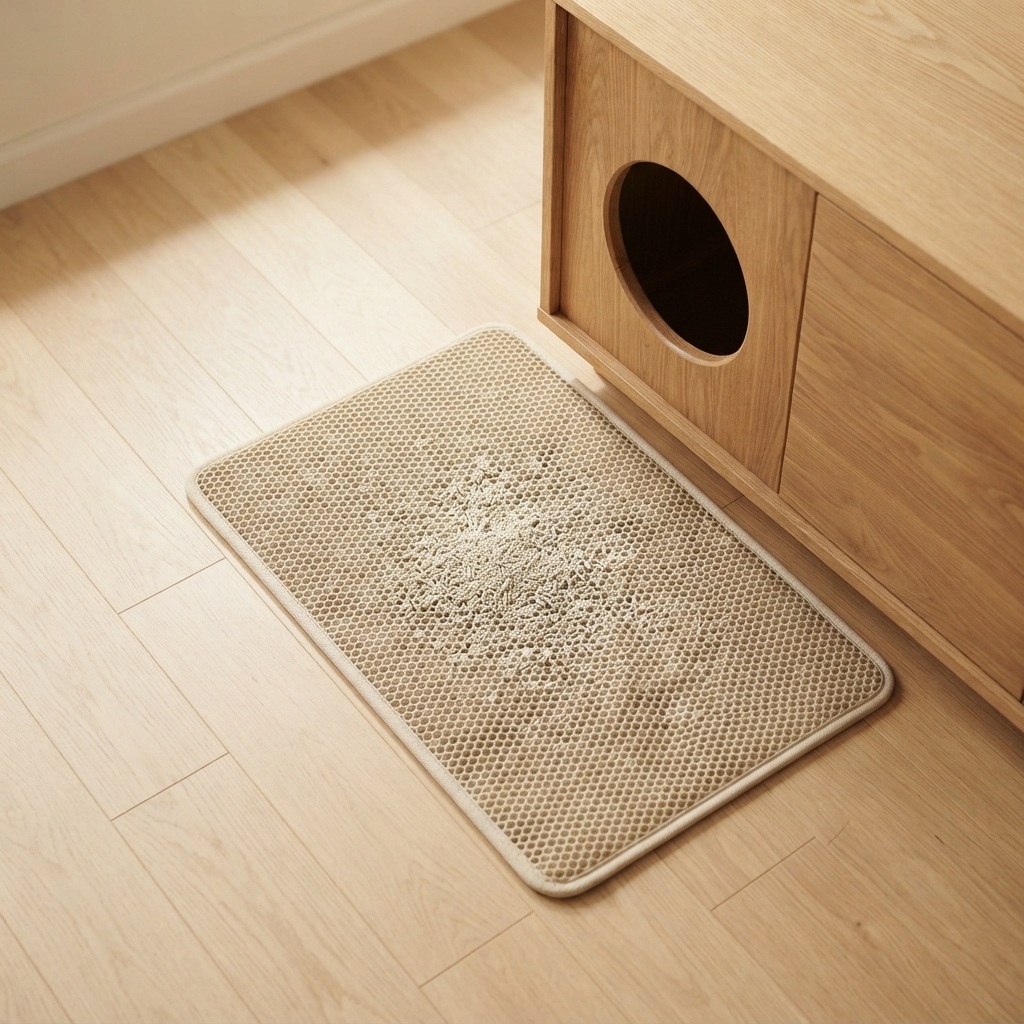
Litter travels on paws and gets everywhere. A mat catches it.
The double-layer kind works noticeably better than a flat one: granules fall through holes in the top surface into a pocket underneath, so they’re trapped rather than sitting on top waiting to be kicked further. Empty it by lifting one edge into the bin.
Buy it wider than you think. Cats leave the tray in whatever direction they feel like, and a mat that only covers the front does half a job.
3. A high-sided open tray

The single biggest cause of litter on the floor isn’t tracking on paws — it’s cats who dig enthusiastically and fling it over the side.
A tray with high sides and a lower entry cut-out solves that without enclosing the cat. Look for something like 20 cm of wall height at the back with a dip at the front for easy entry, especially if your cat is older or arthritic.
Bigger than you think, again. The general guidance is a tray about one and a half times the cat’s length, and most trays sold are smaller than that.
4. A decent scoop and a lidded bin
This sounds like an afterthought and it isn’t.
The reason people scoop every other day instead of daily is friction: a flimsy scoop, and nowhere to put the waste. Fix both and the daily habit sticks — which, as above, is the whole ballgame for smell.
A metal or heavy-duty plastic scoop with the right slot width for your litter, and a small lidded bin beside the box so the waste doesn’t travel through the flat to the kitchen. Together they turn a two-minute job into a twenty-second one.
5. An air purifier, if you’ve done everything else
Worth saying clearly: this is not a substitute for scooping. If the box smells, the box needs cleaning.
Where a purifier does help is the residual ambient smell in a small flat where the box is unavoidably in the living space — the background note rather than the acute problem. A unit with an activated carbon layer, not just HEPA, is what handles odour; HEPA alone deals with particles.
Match the room size, and remember the carbon filter is a consumable.
The one reason to keep looking in the box
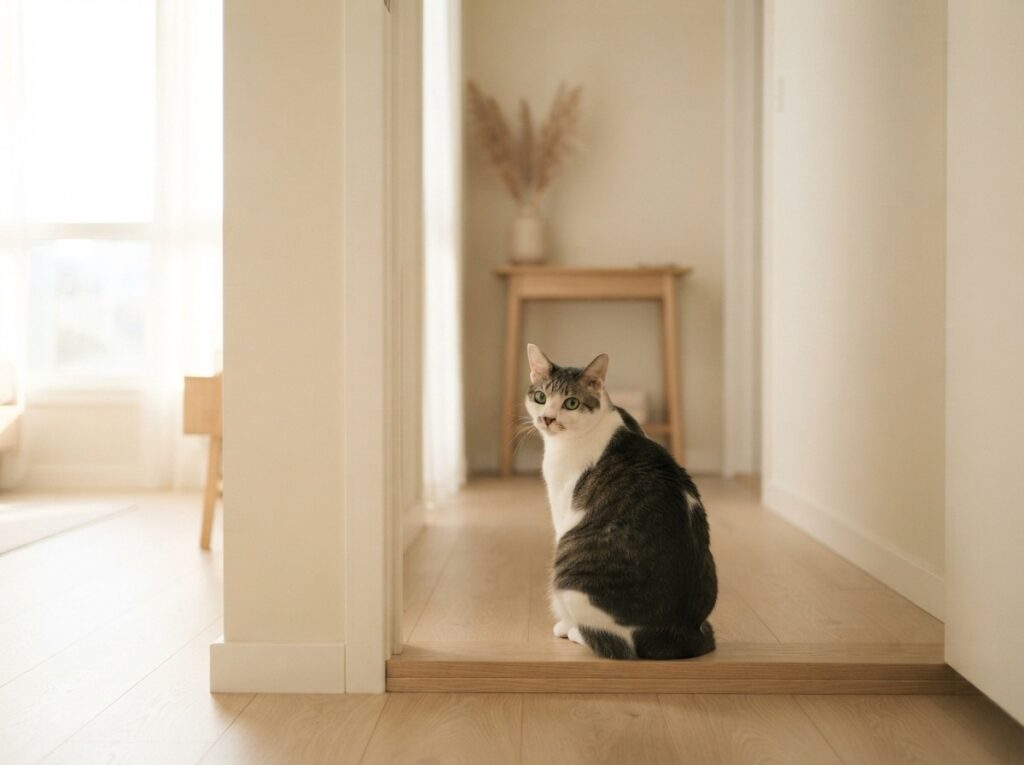
Everything above is about making a litter box less visible. This section is the opposite: however well you hide it, keep looking inside it.
Cats are extremely good at concealing illness. It isn’t stoicism — it’s instinct. A cat that shows weakness in the wild is a cat that gets picked off, so the behaviour is to carry on as normal for as long as possible. Dogs sulk, whine, and go off their routine early. Cats don’t. By the time something is visible from the outside, it has usually been going on for a while.
The litter box is one of the few places that reports on a cat before the cat does.
What to notice — in either direction. Clumps suddenly much larger, or much smaller. More trips, or fewer. Long sits with nothing produced. A change in stool consistency that lasts more than a couple of days. You don’t need to measure anything. You need to know what normal looks like for your cat, so that not-normal registers.
A useful threshold: a sustained change of roughly a third, held for two to three days, is worth a phone call.
Coat is the other one. A coat that turns dull, dry, or unkempt often means the cat has stopped grooming properly — and cats stop grooming when something hurts or when they feel unwell. It’s not a cosmetic problem.
And the part no product solves. There is nothing on this page, or on any page like it, that prevents kidney disease. Chronic kidney disease affects 30–40% of cats over ten and around 80% of cats over fifteen, and two-thirds of kidney function is typically gone before any sign shows. A water fountain may help some cats drink a little more. It is not a substitute for a blood panel.
If your cat is seven or older, ask your vet for a baseline blood and urine test at the next visit, and repeat it yearly. That test is the only thing on this list that finds the problem while it can still be slowed.
I learned this the expensive way, with a fourteen-year-old cat and two months of small signs I explained away.
Three things I’d skip
Hooded litter boxes. They’re the standard advice and I think they’re mostly wrong. They don’t save floor space — same footprint plus a lid — and they concentrate the smell inside, which means you notice it less and the cat notices it considerably more. Cats who suddenly stop using a box often turn out to be avoiding a hood.
Scented litter and deodorising crystals. Cats have a far stronger sense of smell than we do, and a heavily perfumed litter is genuinely aversive to some of them. What smells clean to you can be the reason a cat starts going behind the sofa.
Self-cleaning boxes, at the budget end. The premium ones work. The cheap ones jam, and a jammed automatic box is worse than a manual one because you stop checking it. If you’re not going to spend properly here, don’t spend at all.
Frequently asked questions
How often should I change the litter completely? With clumping litter and daily scooping, a full change every two to four weeks is typical. Wash the tray with unscented soap and hot water when you do — not bleach, and not anything ammonia-based, which smells like urine to a cat.
My cat has started going outside the box. What first? Vet first, before anything else. Sudden litter box avoidance is a very common early sign of urinary tract problems, and it’s genuinely urgent in male cats. Once medical causes are excluded, then look at box cleanliness, location, litter type and competition between cats — in that order.
Is covered furniture bad for the cat, like a hood? Less so, and the reason is volume. A cabinet is a small room with an open doorway; a hood is a box on your head. Cats generally accept furniture enclosures that have room to turn around and a clear exit. If yours doesn’t, take the door off the cabinet and see if that fixes it.
Nothing here makes a litter box invisible. What it does is stop it being the defining feature of the room it’s in — and after twenty-five years, the thing I’d tell anyone starting out is that the ninety seconds each morning matters more than everything else on this list combined.
Related reading
- 9 Small Space Cat Ideas That Don’t Ruin Your Living Room
- How to Stop a Cat Scratching the Sofa
- 12 Pet Products That Actually Look Good in Your Home
Disclosure: As an Amazon Associate, I earn from qualifying purchases. Prices shown are approximate and change frequently; check the current price on Amazon.