Disclosure: As an Amazon Associate, I earn from qualifying purchases.
The standard advice for keeping a cat in a small apartment is to buy less stuff. It’s not wrong exactly, but it’s solving the wrong problem — because the thing your cat is short of usually isn’t stuff. It’s territory.
And here’s the useful part: territory, for a cat, is measured in volume, not floor area. You can’t make your living room wider. You can absolutely make it taller.
That shift helps explain why a 40 m² apartment (about 430 sq ft) can work well for many cats, while a larger apartment can still feel cramped. The layout matters: below are five purchases worth considering and four ideas that cost nothing.
Quick answer: In a tiny living room shared with a cat, the best setup adds usable territory without adding clutter: a window perch, a secure wall route, a properly sized litter cabinet, a mat placed on the cat’s exit route, or a wall-mounted scratcher. Check usable dimensions, fixing method, cleaning access and placement before choosing the finish.
If your cat enjoys a window view, compare the AMOSIJOY Cordless Cat Window Perch on Amazon (paid link) and confirm your glass surface is compatible with its suction cups before buying.
Jump to a product idea: Window perch · Wall shelves · Litter-box furniture · Litter mat · Wall-mounted scratcher
Why vertical space works
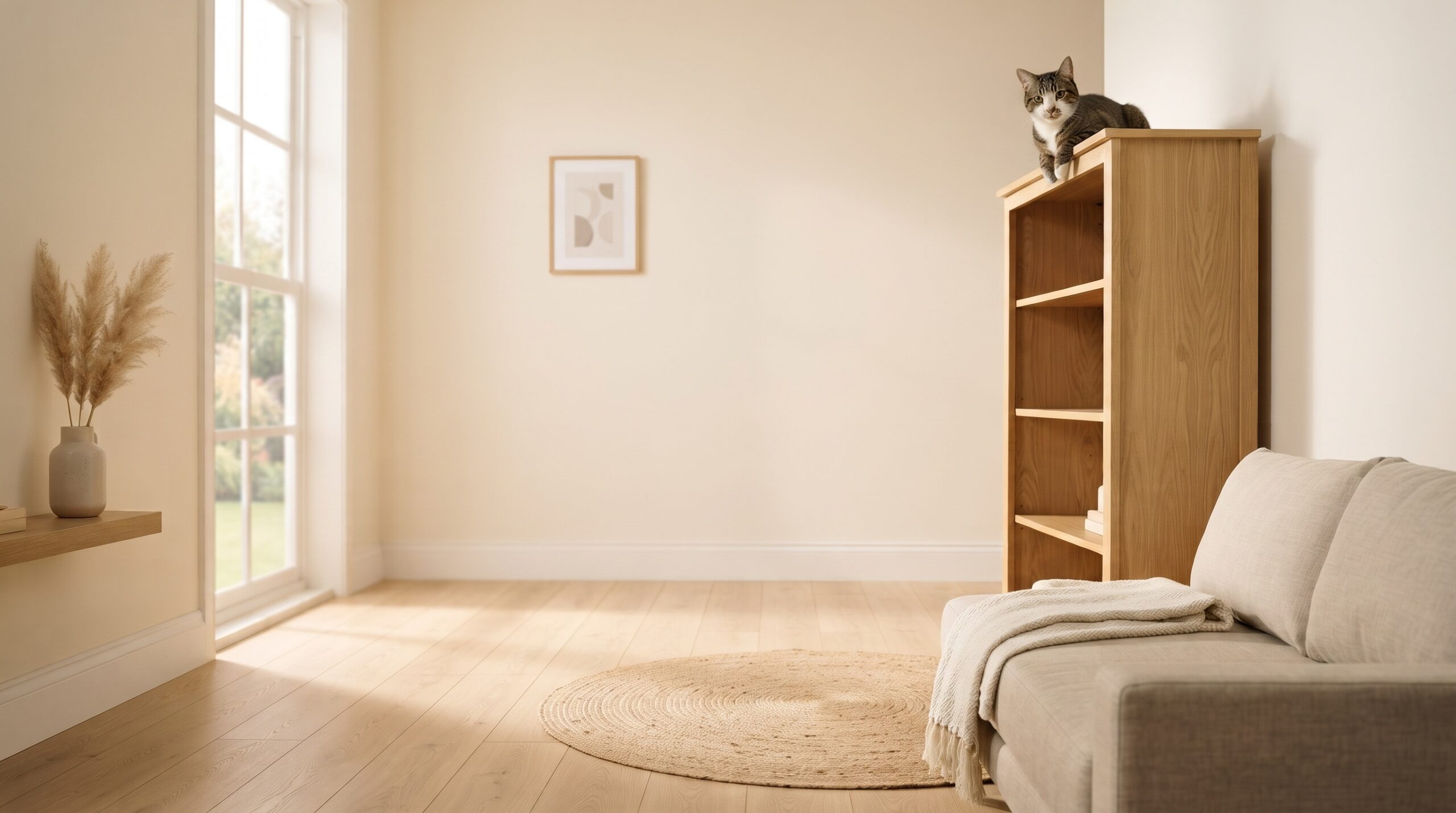
Cats evolved to use height. A raised position gives a wide field of view, an escape route, and distance from anything unpredictable at ground level — which in an apartment might include the entry door, a vacuum, and visitors’ feet.
Three things follow from that, and they’re worth knowing before you buy anything:
A raised resting place can give some cats a quiet place to observe or retreat. In a multi-cat home, add more than one elevated option and make sure each cat can reach and leave it without being cornered. Height can support a more flexible layout, but it does not by itself resolve tension between cats.
In a multi-cat home, some cats may use height to create distance, but they also need separate routes and resting choices. Provide several safe places and keep key resources—food, water, litter, scratching and resting areas—separated where possible. Watch how the cats use the room; a shelf that one cat can block may not give the other a safe retreat.
Height is free. The wall above waist height in most apartments is doing nothing. It’s the only square footage you can add without moving.
The other principle worth holding onto: sightlines matter as much as height. A shelf facing a blank wall gets ignored. A perch with a view of the room, or of the window, gets used constantly. Before mounting anything, sit on the floor where it’ll go and ask what the cat would be looking at.
Cat furniture that actually earns its space
1. A window perch — a high-value spot in a small apartment
If you buy one thing on this list, buy this.
A suction-mounted hammock puts your cat at the window with zero floor footprint. A window perch can add a resting and observation option without taking floor space, but individual cats vary in how much they use a window view. For a suction-mounted model, follow the manufacturer’s installation instructions, use it only on a compatible surface, and check the attachment regularly. Position it where a slip or fall would not put your cat at risk.
2. Wall shelves — the actual solution
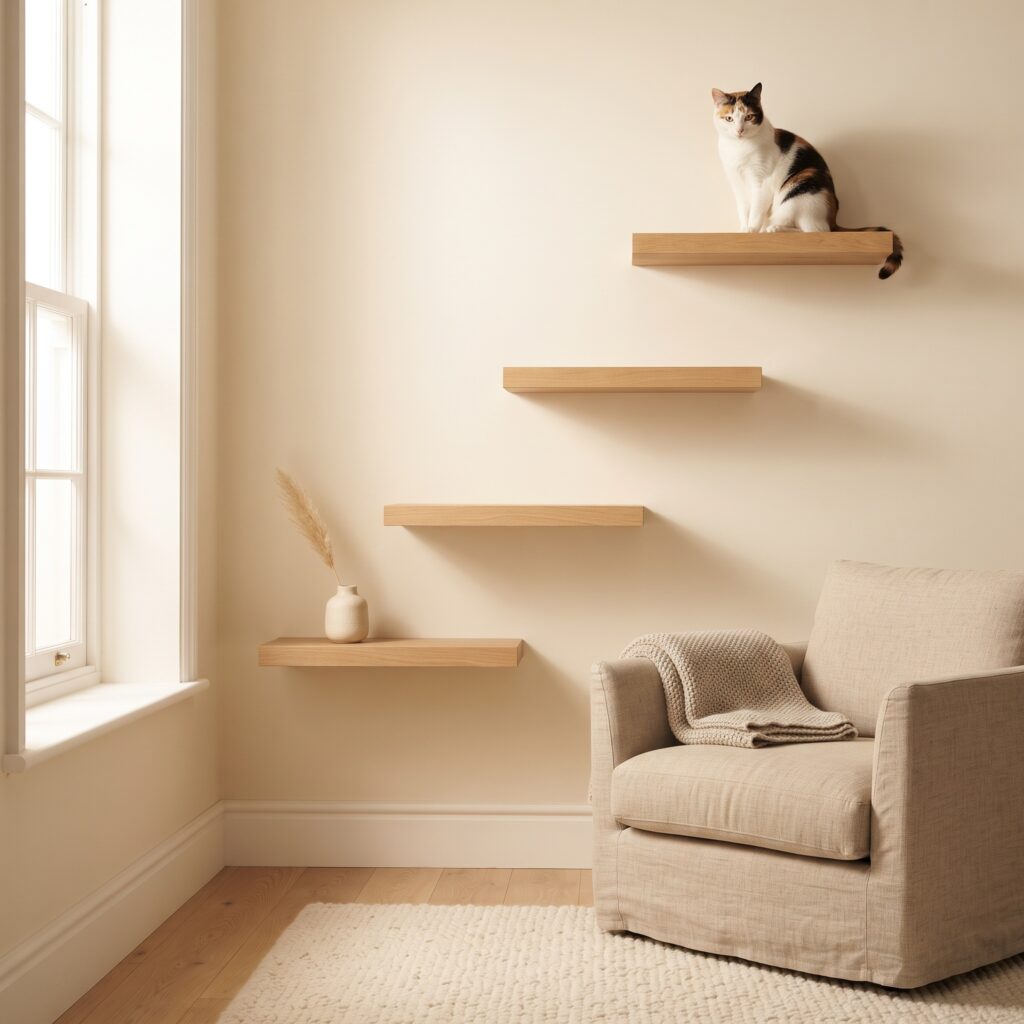
A set of wall-mounted shelves and steps turns an empty wall into a route. Done properly, your cat can get from floor to the top of a bookcase without touching the ground.
The design rule that matters: shelves need to form a path, not a display. Choose the spacing for your cat’s size, age, mobility and confidence. Arrange the steps so your cat can move up and down comfortably, and follow the shelf maker’s fixing and weight-limit instructions. Recheck the fixings periodically.
Give it a destination — the top step should lead somewhere good, like a perch by the window or the top of a cupboard. A route to nowhere doesn’t get walked.
3. Hidden litter box furniture — the biggest visual win
In a small apartment, the litter box may need to sit in a room you use. So the move is to stop trying to hide it and start disguising it.
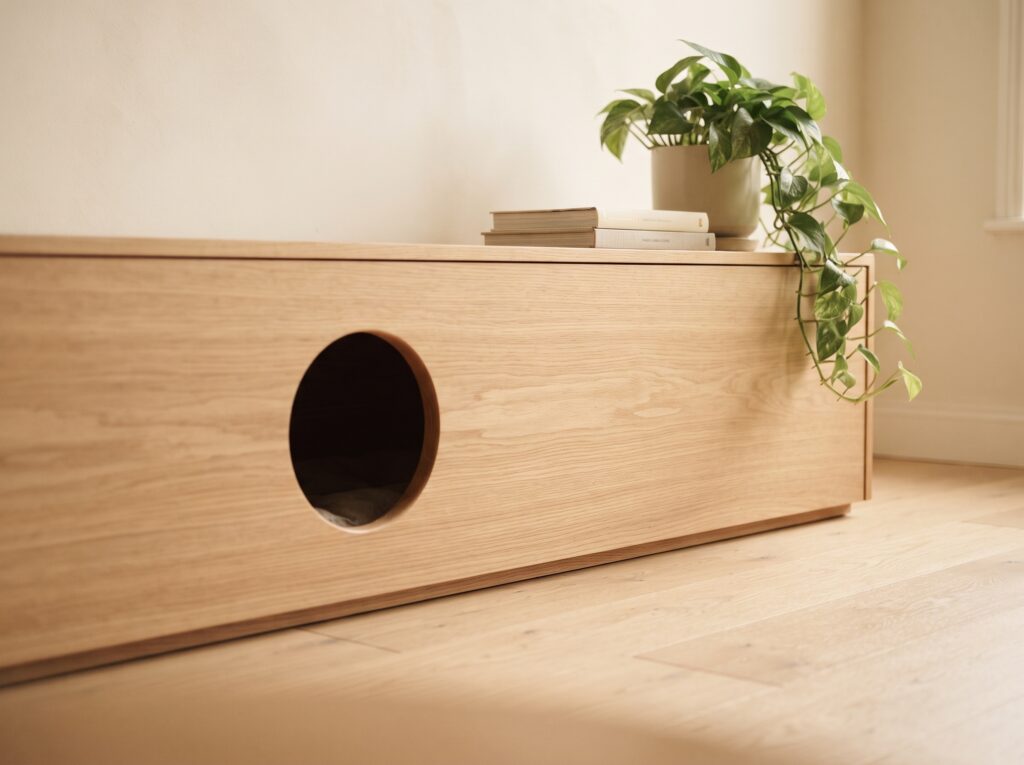
A cabinet or side table with an entrance cut into the side does exactly that. From the outside it’s furniture. Inside it’s a litter box, with the tray contained so scatter stays in the cabinet rather than on your floor.
Before buying, check five things: the usable interior after allowing for hinges and hardware; the entrance width, height and step from the floor; whether a full-size door or lid opens far enough to slide the tray out and clean every corner; the clearance needed around the cabinet where it will sit; and whether your cat is comfortable using an enclosed box. Compare the usable interior with the tray you already own rather than relying on the cabinet’s outside dimensions. If the retailer listing does not give enough measurements to confirm the fit, keep comparing rather than guessing.
This is the most expensive item on the list, and it’s the one that most changes how a small living room feels.
Want more help with box placement, litter scatter and daily upkeep? See our small-home litter box guide.
4. A litter trapping mat
In a small apartment, the litter box may be close to the rooms you use, so some tracking can reach your living space.
A textured or layered mat may catch some loose litter, but results depend on the mat, litter and the route your cat takes after leaving the tray. Measure that route and check the selected mat’s dimensions and cleaning instructions before buying.
5. A wall-mounted scratcher
A floor scratching post costs you floor. A sisal board that mounts to the wall or a door doesn’t.
The height is the point: cats stretch fully when scratching vertically, and a wall-mounted board lets them do that without a base sitting in your room. It also protects the specific bit of wall or door frame they’ve already decided is theirs.
Mount it where they already scratch, not where you’d prefer they scratched. You’re redirecting a habit, not creating one.
Small-space cat furniture checklist
| Type | Floor space | Fixing or fit check | Main limitation |
|---|---|---|---|
| Window perch | None | Clean glass and inspect every suction cup | Only useful where the cat has a view |
| Wall shelves | None | Use suitable studs or wall anchors and build a route | Needs secure installation and leaves fixing holes |
| Litter cabinet | Furniture footprint | Measure usable interior, entrance, door swing and tray removal | Not every cat accepts an enclosed box |
| Litter mat | Low, but not zero | Cover the cat’s first steps after leaving the tray | A front-only mat fails when the cat exits sideways |
| Wall scratcher | None | Mount where the cat already scratches and allow a full stretch | Wrong placement makes a good scratcher irrelevant |
Four more ideas that cost nothing

Some cats choose a high resting place; others prefer a covered or lower spot. Clear one stable surface and offer a choice, then see which place your cat actually uses.
Keep food and water separate from litter areas where your layout allows. Cats’ preferences vary, so observe where your cat is comfortable eating and drinking instead of relying on a fixed distance. In a small apartment, a separate corner or another room may help create clearer zones.
Use the space under the bed properly. Not for the cat — for the cat’s supplies. Litter, food, spare toys, the carrier. Under-bed storage is the most underused volume in a small apartment, and getting bulky supplies out of your cupboards buys you back the space you actually notice.
Rotate the toys you already own. Keep most toys in a cupboard and leave out only a few, then swap them every week. This reduces floor clutter and gives your cat a change without buying another basketful.
Five things I’d skip
Tall cat trees, floor-standing or floor-to-ceiling. A tall cat tree can take more floor space than a small room can spare. Before buying one, compare the base footprint, fixing method and the route your cat would use. Wall shelves can use an otherwise empty wall, provided they are installed securely.
Door-mounted cat towers. A door-mounted tower saves floor space, but the door may move while a cat is using it. Check the mounting hardware, door clearance and weight limit, and consider whether your cat is comfortable with a moving platform. If drilling is not possible, a stable window perch may be simpler to place.
Cat tunnels and floor-level play furniture. Fun, and cats do use them — but they consume floor space, which is exactly the resource you’re short of. In a larger apartment, floor-level play furniture may fit; in a small space, check the footprint first.
Enclosed hooded litter boxes as a space solution. An enclosed box can make the tray less visible, but it does not reduce the cabinet’s floor footprint. Some cats may avoid covered boxes; Cornell’s Feline Health Center notes that many cats prefer an uncovered box and that covers can hold odors in. If your cat is reluctant to use an enclosed setup, offer an accessible uncovered option and ask your veterinarian about a sudden change in toileting habits.
Multi-tier cat trees under about 120 cm. They occupy the footprint of a real cat tree while delivering height your cat could reach by jumping on the sofa. Either go properly tall or go wall-mounted; the middle is the worst of both.
Frequently asked questions
How many litter boxes do I need in a small apartment? General guidance is one litter box per cat, plus one extra — two for one cat and three for two. A small home can make that difficult, so place boxes in separate, accessible locations where possible. If your cat avoids the box or its toileting habits change, ask your veterinarian for advice.
Will wall shelves damage my rental? They need fixings, so yes, there will be holes. Filling and repainting a few anchor holes is normally accepted end-of-tenancy work, but check your agreement. If drilling is genuinely out, the window perch and a corner tree get you most of the vertical benefit with no fixings at all.
My cat ignores everything I buy. What am I doing wrong? Usually placement, not product. Cats use things that are on a route they already walk, near a view they already like, or in a spot they already sit. Watch where your cat actually goes for a few days, then put the thing there. A perch in the wrong corner will sit unused for years.
None of this makes a small apartment bigger. What it does is help the apartment and the cat use the same floor space more comfortably — and once you’ve built upwards, the room you get back is yours.
Related reading
- How to Keep a Litter Box From Taking Over Your Home
- How to Stop a Cat Scratching the Sofa
- 12 Pet Products That Actually Look Good in Your Home
Disclosure: As an Amazon Associate, I earn from qualifying purchases.