Category: Training & Behaviour

  • How to Stop a Cat Scratching the Sofa (Without a Spray Bottle)

    Disclosure: As an Amazon Associate, I earn from qualifying purchases.

    In twenty-five years of living with cats I have lost exactly one sofa, and it was entirely my fault. I bought a scratching post, put it in the corner of the room where it looked tidiest, and then wondered why the cat kept using the arm of the sofa instead.

    The mistake is almost universal, and once you understand it the problem becomes much more solvable than it looks.

    Why cats scratch, and why it isn’t naughtiness

    Scratching does three things at once, and none of them are about sharpening claws in the way people assume.

    It’s a stretch. Watch a cat scratch and they extend the whole body, shoulder to hip. It’s the feline equivalent of a full-body reach after sleeping.

    It sheds the outer claw sheath. The old layer flakes off. That’s the “sharpening” part, and it’s maintenance rather than weapon-making.

    It’s a territorial marker. There are scent glands in the paw pads, and a scratched surface carries a visual mark and a chemical one. This is the part that explains everything about location.

    Because scratching is territorial signalling, cats scratch where the signal counts: on the route through the room, near where they sleep, and at the entrance to a space. A sofa arm sits exactly at those coordinates. A post in the corner does not.

    That’s the whole problem. Not the post, not the cat — the map.

    The rule that fixes most of it

    Put the scratcher where the cat is already scratching. Not where you’d prefer it. Not where it looks tidy.

    If the cat is doing the arm of the sofa, the scratcher goes beside the arm of the sofa. It looks silly for a few weeks. You can move it gradually — a few inches a week — once the habit has transferred, and most cats will follow it. Move it too early and they go back to the sofa.

    Three secondary rules that matter almost as much:

    It has to be tall enough to stretch on. Roughly 80 cm minimum for an adult cat. The very common short posts are too short to be worth using; the cat can’t get the stretch, so the sofa still wins.

    It has to be rigid. If it wobbles, it’s rejected. Cats put real weight through a scratch, and an unstable post is unpleasant and slightly alarming.

    Cats have a texture and orientation preference. Some are vertical scratchers, some horizontal. Some want sisal rope, some want cardboard, some want carpet. Watch which surface yours has chosen and buy that.

    What to buy

    1. A tall, rigid sisal post

    The default and the one to start with, provided you get the height right.

    Look for at least 80 cm of scratchable surface — not total height including a platform — and a base wide and heavy enough that it doesn’t rock when pushed hard at the top. Sisal rope wound around a post lasts considerably longer than sisal fabric.

    If your flat is short on floor space, look for a slim design or a corner unit rather than one with a wide sprawling base.

    What I’d buyAmazon Basics Sturdy Cat Scratching Post★★★★★★★★★★4.59,200 reviews~$37

    2. A wall-mounted sisal board

    The zero-footprint option, and the one I’d suggest if the cat’s chosen spot is a wall, a door frame, or the side of a bookcase.

    Mounted at full stretch height it gives the vertical extension a post does, without a base in the room. It also lets you put the scratcher precisely where the cat has decided the territory marker belongs, which a freestanding post can’t always manage.

    Mount it slightly higher than you think — measure your cat stretched up against the wall.

    What I’d buy34″ Wall-Mounted Sisal Cat Scratcher★★★★★★★★★★4.6598 reviews~$27

    3. A horizontal cardboard scratcher

    Cheap, and worth buying even if you already have a post, because it costs almost nothing to test which orientation your cat prefers.

    A lot of cats are horizontal scratchers and their owners have never found out, because every product marketed at them is a vertical post. If your cat scratches the carpet or the rug rather than furniture, this is the one you need.

    They’re consumable. A well-used one lasts a few months. Buy the double-sided kind and flip it.

    What I’d buyZOMISIA Double-Sided Cardboard Scratcher Lounge★★★★★★★★★★4.6589 reviews~$23

    4. Furniture protectors, as a temporary measure

    Clear vinyl panels that pin to the corner of a sofa.

    I want to be honest about these: they work, and they are ugly. They’re a bridge, not a solution — you use them for the weeks while the new scratcher is establishing itself, then take them off. Left on permanently they just move the problem to a different piece of furniture.

    Get the ones with twist pins rather than adhesive. Adhesive backing on upholstery is a bad idea.

    What I’d buyFixZilla Cat Scratch Furniture Protector, 10-Pack★★★★★★★★★★4.48,400 reviews~$20

    5. Catnip or silvervine, to make the new post the interesting one

    The transfer goes faster if the scratcher is genuinely more attractive than the sofa, and this is the cheapest way to tilt it.

    Rub it into the sisal rather than sprinkling it on. Reapply weekly for the first month — the scent fades fast and the association needs repeating.

    Worth knowing: roughly a third of cats don’t respond to catnip at all; it’s hereditary. If yours is one of them, silvervine works on many catnip-immune cats and is worth trying instead.

    What I’d buyPotaroma Natural Silvervine Sticks★★★★★★★★★★4.36,800 reviews~$7

    Three things I’d skip

    Spray bottles, and punishment generally. Twenty-five years and I have never seen this work — the same twenty-five years behind what I’d tell anyone about litter boxes. What it teaches is that you are unpredictable — the cat learns to scratch the sofa when you’re not in the room, and separately becomes warier of you. You’ve kept the behaviour and lost some trust.

    Anti-scratch sprays that claim to repel. Occasionally one works on one cat. Mostly they don’t, and the ones that do work fade within days. Redirecting to a better option beats trying to make the sofa unpleasant.

    Declawing. It’s an amputation of the last bone of each toe, not a nail trim. It’s banned or restricted in much of the world, and it’s associated with long-term pain and litter box avoidance. If someone suggests it, the answer is no.

    Frequently asked questions

    How long does it take to redirect a cat? Usually two to four weeks with the scratcher in the right place, faster with catnip. If nothing has changed after a month, the location, the height or the texture is wrong — change one variable at a time.

    Should I trim my cat’s claws? It helps, and it reduces damage when scratching does happen. Every couple of weeks, just the sharp translucent tip, well clear of the pink quick. It doesn’t remove the urge to scratch, so it’s a supplement rather than a fix.

    My cat suddenly started scratching much more. Why? Sudden increases in territorial marking often follow a change: a new pet, a house move, a new person, building work next door, or a strange cat visible through a window. Worth looking for the trigger rather than only treating the symptom.


    The sofa I lost was replaced by a post placed forty centimetres from where the damage had been, with catnip rubbed into the rope. It took about three weeks. Nothing about the cat changed — I just finally put the thing where she had been telling me to put it all along.


    Disclosure: As an Amazon Associate, I earn from qualifying purchases. Prices shown are approximate and change frequently; check the current price on Amazon.
  • 7 Indoor Boredom Busters for High-Energy Dogs

    7 Indoor Boredom Busters for High-Energy Dogs

    Disclosure: As an Amazon Associate, I earn from qualifying purchases.

    There’s a moment familiar to anyone with an energetic dog: you’ve just come back from a long walk, you’re tired, and the dog is standing by the door looking at you like nothing happened.

    The instinct is to walk further. It rarely works, and with some dogs it makes things worse — you build fitness, they need more, and you end up in an arms race you can’t win.

    What works better is changing the kind of work rather than the amount.

    Why mental work tires a dog faster

    A dog’s nose is doing serious processing. Scent work engages a huge amount of neural real estate, and the effort involved is real — dogs doing sustained sniffing work show physical signs of exertion without moving much at all.

    The practical upshot, which most owners find hard to believe until they try it: fifteen minutes of concentrated sniffing or problem-solving will settle a dog more reliably than an extra half hour of walking. Not because it’s harder physically, but because it satisfies something the walk didn’t.

    Two mechanisms are worth understanding, because they tell you which tool to reach for:

    Sniffing calms. Searching for food engages what behaviourists call the seeking system — the same drive that makes a dog investigate a hedge for ten minutes. It’s absorbing, it’s self-directed, and dogs come out of it calmer than they went in.

    Licking calms differently. Sustained licking is a self-soothing behaviour. It’s repetitive, rhythmic, and it tends to drop a dog’s arousal level rather than raise it. That makes it the right tool for a specific job: not “tire the dog out” but “bring the dog down” — before guests arrive, during fireworks, when you need to work.

    Those are different problems, and the difference matters when you’re choosing what to buy.

    The rule nobody mentions

    An overhead view of a sage green silicone lick mat spread with peanut butter on an oak floor

    Almost everything below uses food. If you add all of it on top of your dog’s normal meals, you will have a fat dog by spring.

    Take the food out of their daily ration, not in addition to it. A stuffed lick mat can easily be a third of a small dog’s breakfast. If you’ve just brought a dog home, the first-month checklist covers when to introduce each of these. The easiest system is to weigh out the day’s food in the morning and feed it entirely through enrichment — no bowl at all. Dogs work for food willingly, and it turns an unavoidable daily task into the enrichment itself.

    What to use

    A sage and oatmeal snuffle mat on a wool rug with a golden retriever lying beside it

    1. A lick mat — for bringing a dog down

    A textured silicone mat you spread something soft across — wet food, plain yoghurt, mashed banana, pumpkin. The texture means the dog has to work at it, which stretches a few spoonfuls into ten or fifteen minutes of steady licking.

    Best for: settling before guests arrive, during a thunderstorm, or when you need forty minutes of quiet.

    Get one with a suction base if your dog is the type to pick things up and carry them off. And freeze it — a frozen mat takes three to four times longer than an unfrozen one, which is the difference between five minutes and twenty.

    What I’d buyLUKITO Lick Mat with Suction Base, 2 Pack★★★★★★★★★★4.48,700 reviews~$9

    2. A snuffle mat — the highest-value item here

    A mat of dense fabric strips that you scatter dry food into. The dog has to nose through the fabric to find it. It looks almost too simple to work, and it’s the most reliably effective thing on this list.

    Best for: daily use. This is the one to buy first.

    Start easy — food on top, visible — for the first few goes. If the first experience is too hard, some dogs decide the mat isn’t worth investigating and won’t come back to it. Once they’ve got it, bury the food deeper.

    Buy a washable one and wash it. Dry food leaves oils in the fabric and an unwashed snuffle mat goes rancid faster than you’d think.

    What I’d buyPET ARENA Adjustable Snuffle Mat★★★★★★★★★★4.38,000 reviews~$11

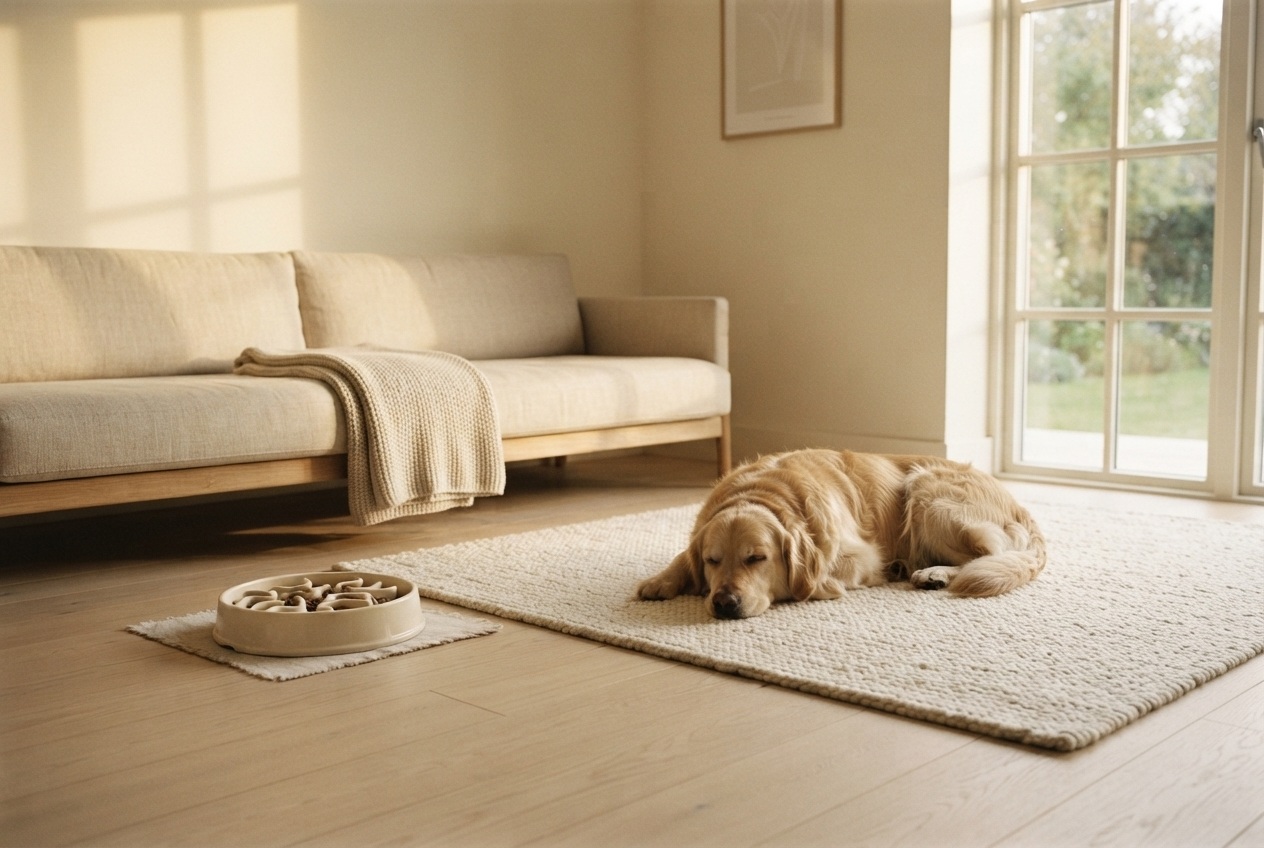
    3. A slow feeder bowl — the zero-effort upgrade

    A bowl with a moulded maze in the base. Your dog eats the same food, just around ridges instead of straight up.

    Best for: fast eaters, and anyone who wants an improvement that costs nothing to maintain.

    It won’t tire a dog out — it’s not enrichment in the way the snuffle mat is. What it does is stretch a thirty-second meal into five or ten minutes, which reduces gulping and the bloating that follows.

    Match the maze complexity to the nose. Flat-faced breeds struggle with deep narrow channels; look for shallow, wide patterns for pugs, bulldogs and similar.

    What I’d buyOutward Hound Fun Feeder Slo Bowl★★★★★★★★★★4.6136,000 reviews~$9

    4. A treat-dispensing rubber toy — the classic

    The rubber toy you stuff and the dog works food out of. It’s been around forever because it works and it’s close to indestructible.

    Best for: crate time, being left alone, and anything where the dog needs a job that lasts.

    The trick is stuffing it properly. Loose kibble falls out in ninety seconds. Pack it, add something sticky to hold it together, and freeze it — a well-packed frozen one can occupy a determined dog for half an hour or more.

    Size up rather than down, and check it regularly for damage. A chewed-through rubber toy stops being a toy and becomes a hazard.

    What I’d buyKONG Classic Dog Toy★★★★★★★★★★4.693,000 reviews~$12

    5. An interactive puzzle toy — for the dogs that need more

    Sliding covers, flip lids, rotating discs. Real problem-solving rather than nose work.

    Best for: clever dogs who solve the snuffle mat in four minutes and look at you expectantly.

    Start at level one, even if you think your dog is smart. The failure mode here is a dog who can’t work it out, gets frustrated, and stops engaging — and that’s much harder to undo than starting too easy.

    Supervise the first few sessions. A puzzle a dog can’t solve is a puzzle some dogs will simply chew through.

    What I’d buyNina Ottosson Dog Smart Puzzle (Level 1)★★★★★★★★★★4.417,000 reviews~$13

    6. A treat pouch — for the free option

    The most underrated item, because it isn’t really about the pouch. It’s about making five-minute training games frictionless.

    Ten minutes of teaching a new trick is genuinely tiring for a dog — focus, impulse control, repeated decisions. But it only happens if the treats are already to hand. A pouch on a hook by the door means the barrier drops from “go find the treats, wash hands, start” to nothing.

    Get one with a hinged opening that snaps shut rather than a drawstring. You’ll be reaching in one-handed while the other hand is doing something else.

    What I’d buyheouvo Magnetic Dog Treat Pouch★★★★★★★★★★4.54,100 reviews~$10

    7. The one that costs nothing: scatter feeding

    Take your dog’s dry food. Throw it across the lawn, or across a rug indoors. Walk away.

    That’s it. Ten to twenty minutes of nose-down searching, no equipment, no cost. It works on the same principle as the snuffle mat and it’s how I’d suggest testing whether scent work does anything for your dog before spending money on it.

    Indoors, use a low-pile rug or a towel spread out — smooth floors mean the food skitters and the searching part disappears.

    Three things I’d skip

    An overhead view of a cream slow feeder bowl filled with kibble in its winding channels

    Automatic ball launchers. They look like the perfect solution — endless fetch without your arm. The problem is that repetitive high-speed chasing raises arousal rather than lowering it, and some dogs develop a genuinely obsessive relationship with the ball. You end up with a dog who is fitter, more wound up, and harder to switch off.

    TV channels made for dogs. Passive watching isn’t enrichment. Some dogs are mildly interested for a few minutes; most ignore it entirely. It doesn’t engage the nose, the brain, or the body.

    Puzzle toys above level 2, bought first. Advanced puzzles are the most common enrichment purchase that ends up in a cupboard. Dogs need to learn how to engage with puzzles at all before difficulty means anything.

    Frequently asked questions

    How long should an enrichment session be? Shorter than you’d think. Ten to fifteen minutes of concentrated nose work is a real session. Two short sessions beat one long one, and stopping while the dog is still keen is what makes them enthusiastic next time.

    My dog finishes everything in two minutes. What now? Freeze it, pack it tighter, or make it harder to reach — put the snuffle mat inside a box, or the stuffed toy under a blanket. Difficulty is usually a presentation problem, not a product problem.

    Can this replace walks? No. Walks provide exercise, novelty and outdoor scent that indoor work can’t match. This is for the gap between what a walk delivers and what your dog still needs — which for a young working breed can be substantial. On days when a proper walk isn’t possible, it’s a reasonable stand-in for one day, not a replacement.


    The measure of whether this is working isn’t whether your dog enjoys it — most dogs enjoy anything involving food. It’s what happens twenty minutes afterwards. A dog who settles on their own, without being told, has had the thing they were actually asking for.


    Disclosure: As an Amazon Associate, I earn from qualifying purchases. Prices shown are approximate and change frequently; check the current price on Amazon.